1. Select a tour & submit
Browser a tour that most suits you and send us the tour with your custom request.
2. Quote for your tour
Receive our tour proposal with rates in one working day.
3. Adjust your tour
Modify your itinerary with new quotes for free until it fits you.
4. Confirm & deposit
Finalise your tour after receiving your deposit.
5. Final payment
Pay the balance before or upon arrival.
We had an absolutely perfect day with our tour guide - Rogin Luo - who took us for a hike along The Great Wall! Didn't know what to expect and were thrilled to have him as our guide. Very imformative, knowledgable and fun! We go to experience a part of The Great Wall that was unrestored and see all its natural beauty. Got a long history lesson along the way!
After the hike, we all went to lunch at a small place at the bottom of the hill. Located in a house, we ate lunch in the proprietors bedroom! What a hoot! Rogin is the Best of the Best! This tour company delivered for us and we are extremely grateful.
Located in the north of Shanxi Province,about 400km west of Beijing, Datong is one of the famous historical and cultural cities in China. It was the ancient capital of Northern Wei Dynasty from 398 AD until 494 AD. The ancient Datong was also the Western Capital of Liao Dynasty (916 - 1125) as well as the Western Capital of the Jurchen Jin Dynasty (1115–1234).
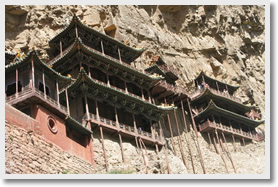
The main sights in Datong are Datong Great Wall, Yungang Grottoes, Hanging Temple, Yingxian Wooden Tower, Datong Ancient City Wall, Nine-dragon Wall, Huayan Temple, Shanhua Temple. Datong Drum Tower, Henshan Mountain and etc. Spring, summer and autumn are the ideal seasons for visiting Datong.
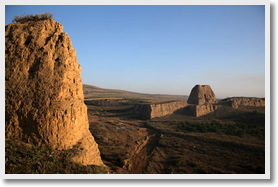
Datong Great Wall is on the central section of the Great Wall of China. With a total length of over 400 km, Datong Great Wall is composed of Outter Great Wall and Inner Great Wall. Largely different from the brick and stone Great Wall around Beijing, Datong Great Wall is mostly made of earth tamped down between planks in layers one on top of the other.
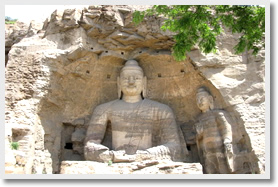
The four main sites in China that are famous for their stone sculpture are Dunhuang in Gansu, Luoyang Longmen and Datong Yungang and Tianshui Majishan Grottoes. Among these, the Yungang grottoes are considered the first among equals, for their tremendous size, their ancient history and their relatively complete state of presenvation.
Datong Great Wall is on the central section of the Great Wall of China. With a total length of over 400 km, Datong Great Wall is composed of Outter Great Wall and Inner Great Wall. Largely different from the brick and stone Great Wall around Beijing, Datong Great Wall is mostly made of earth tamped down between planks in layers one on top of the other.
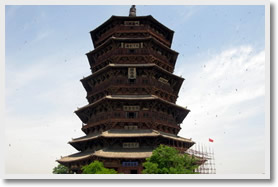
The real name of the Wooden Pagoda in Yingxian Country is the Sakyamuni Pagoda. Situated in western Yingxian coutry, the tower is 70 kilometers away from Datong. It is shaped in an octagon and is 67.13 meters high and 30 meters in diameter at the bottom. It was built in Liao Dynasty in 1056. The wooden tower was completely made of wood without a single nail.
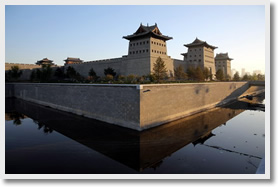
Today'ancient city wall in Datong is a recent restoration of the city wall in Ming Dynasty ( 1368 - 1644 ) when Datong was designated as one of the 9 military towns outside Beijing defending against the steppe nomads along the Great Wall of China. The ancient city wall is 14 meters in height and square in shape with a perimeter of 6.5 km.
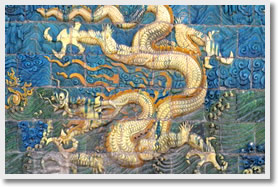
Set up in 1392 during the reign of Hongwu of the Ming Dynasty, the Nine-Dragon Wall in Datong was originally built as a screen wall to go in front of the mansion of the 13rd son of the first Emperor of Ming Dynasty, Zhu Yuanzhang with with 45.5 meters long, 8 meters high and 2.02 meters wide.
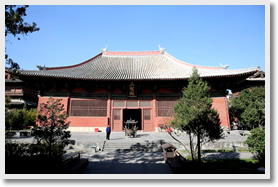
Huanyan Temple, located in the southwest of Datong City, is one of the biggest temples in China built in Liao Dynasty. It got its name because it was and remains a major temple of the Huayan sect, a sub-category of the Buddhism popular in north China.
The Huayan Temple is divided into two parts parts: the Upper Huayan Temple and Lower Huayan Temple which have their own gate and architecture respectively. In 1963, the two separated temple combined a whole temple.
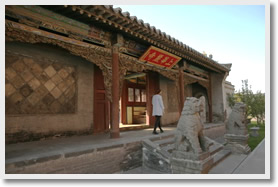
Also named Southern Temple as it lies near the south gate of Datong City in Shanxi Province. Shanhua Temple was originally founded during the Tang Dynasty (618-907) but it was destroyed by war at the end of the Liao Dynasty (916-1125). During the Jin Dynasty (1115-1234) it was rebuilt on a large scale. It has been preserved well until now.
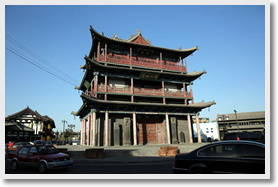
Like many cities in China, Datong has its own Drum Tower. Located in the middle section of South Street, Drum Tower is a typical Ming Dynasty-style architecture remedied many times in Qing Dynasty.Datong Drum Tower has three layers with 17.65-meter long, 14.55-meter wide and 20-meter high surrounded by a cloister.
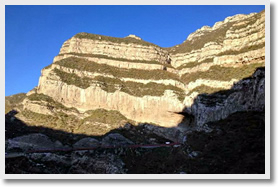
Located in Hunyuan Country of Shanxi Province in Northern China, Mt. Hengshan is one of the five mythical mountains of China (the others being MT. Taishan in Shandong Province; Mt. Huashan in Shaanxi Province; Mt. Hengshan in Hunan Province and Mt. Songshan in Henaa Province).





 Here is only for Questions and Answers. ( For anyone who wants to have an enquiry or customized tour, please email us to
  . )
. )