
Evening Stroll along the Ming Dynasty City Wall in Beijing

June 19th, 2013

 Bombarded by the high rises and futuristic buildings of Beijing, you may be a bit disappointed at the superficial modernity of Beijing with “traditional Chinese elements” diminishing fast. But opposite to that trend, the Beijing government has been doing proactively to restore the historical sites in Beijing. Beijing Ming Dynasty Wall Relics Park is the result of such a great effort made to be reminiscent of Beijing’s glorious past.

The remnants of the city wall left from Ming Dynasty (1368 – 1644) is about 1.5km in length winding from east to west. On its southeast corner stands a massive tower (known as Arrow Tower) of the former inner city in Ming and Qing Dynasties.

Walking close to the ancient city wall, you will feel you are being brought back to the cold weapons era when a defensive thick wall is a symbol of a strong nation.

The wall relics park is free of charge except the magnificent tower (RMB10). It is a pleasant walk along the brick-paved path paralleling the wall.

The remaining city wall presents itself different views formed by particular weathers, different time of the day and the seasons.

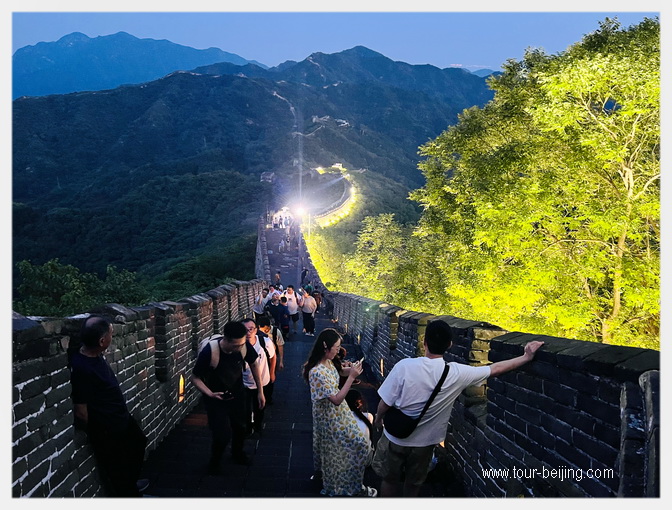
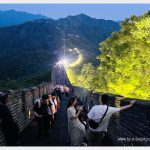
In summer, pick a fine day and go to the city wall park for a leisure stroll and immersed in history. The ancient city wall park is at its best when night falls with lights lit brilliantly.

Follow me to have a leisure stroll along the Ming Dynasty City Wall.

Walking on the brick-paved pathway in the park.

walking on the brick-paved pathway.

walking on the brick-paved pathway.

No more lonely

No more lonely

No more lonely

The Massive Remaining City Wall

The  Massive Remaining City Wall

The Massive Remaining City Wall

A big curve road enables you to have a close look at the City Wall.

A big curve road enables you to have a close look at the City Wall.

A big curve road enables you to have a close look at the City Wall.

The brightly lit  Arrow Towe  ( Dongbianmen Tower ) – Corner Tower

Dongbianmen Towe

Dongbianmen Tower


Evening exercises at the Ming City Wall

Exercises at the City Wall

Exercises at the City Wall


Any questions, just drop a line.

Shichahai in the early morning

June 17th, 2013


Plan your Beijing tour? Pick a fine day for an early morning stroll along the shores of the three lakes of Shichahai - Qianhai Lake ( Front Lake ), Houhai ( Back Lake ) and Xihai ( West lake ). Qianhai and Houhai are linked by the famous bridge known as Yinding Bridge ( Ingot Bridge ). So Shichahai is the collective name for the three lakes which are roughly located between Drum Tower (Bell Tower and the northern gate of Beihai Park.
 
The Yinding Bridge links the Houhai Lake and the Qianhai Lake with the reflection of the rising sun on the water surface of the Houhai Lake.
 

the reflection of the rising sun on the water surface of the Houhai Lake

the reflection of the rising sun on the water surface of the Houhai Lake

 
Many residences along the lake shores have been converted into bars, cafes and restaurants. Shichahai (Qianhai and Houhai in particular) is now well known for the spectacular nightlife
 

Many residences along the lake shores have been converted into bars, cafes and restaurants

Many residences along the lake shores have been converted into bars, cafes and restaurants

 
Standing on the Yinding Bridge and look at the Houhai Lake surrounded with marble railings.
 

Houhai Lake surrounded with marble railings.

Houhai Lake surrounded with marble railings.

 
Fishing is not allowed on the three lakes to protect the lake conditions. But you will find a big number of local anglers sitting aound the lakes for fishing.
 

Fishing at Shichahai

Fishing at Shichahai

 
The rising sun casts its reflection the Qianhai Lake dotted with the floating lotus leaves.

The rising sun casts its reflection the Qianhai Lake dotted with the floating lotus leaves.

 
Qianhai Lake is a perfect place for killing your leissure time – boating and drinking.
 

Qianhai Lake is a perfect place for killing your leissure time

Qianhai Lake is a perfect place for killing your leissure time

 
Only fishing and nothing else, a good pastime for hardworking people.
Only fishing and nothing else,

Only fishing and nothing else,

Shangdu Travel Guide – Xanadu Guide

June 14th, 2013


Also known as Xanadu, Shangdu in Chinese literally means “Upper Capital”, which was the summer capital of Kublai Khan’s Yuan Dynasty (1271 – 1368) in China. In the ruins of Shangdu, a spectacular civilization, a masterpiece of the multi-culture mix was discovered. It was a green city built by the nomads in Yuan Dynasty incorporating multi civilizations. The city, originally known as Kaiping, was later renamed Shangdu. Today, only the ruins remain, and surrounded by a grassy mound that was once the city wall.
a grassy mound that was once the city wall.

a grassy mound that was once the city wall.

 
The famous Venetian traveller Marco Polo visited Shangdu in about 1275 was received by Kublai Khan in the city. In his book, He described the city of Shangdu: “A city called Shangdu, which was constructed by the Khan who is now in power. There are many palaces built out of stones in the city. All the houses are covered with gold and decorated with the pictures of birds, animals and flowers. These buildings and patterns are so pretty that they are appealing to the eye.” From what Marco Polo described, we can imagine how prosperous and luxury the city was at that time.
 
It was designed by Liu Bingzhong, Kublai Khan’s adviser of Han ethnic group. The city of Shangdu took four years’construction, and was finished in 1256. The design of the upper capital reflected the layout of a traditional Han Chinese city and at the same time incorporating the habit of Mongolians’nomadic life style. In 1369 Shangdu was taken and destroyed by the Ming army. Today, only the ruins remain, and surrounded by a grassy mound that was once the city wall
 
Shangdu was immortalized as Xanadu by English poet Samuel Taylor Coleridge, who wrote the well-known poem titled Kubla Khan. Coleridge’s description of Shangdu has the elements of the works of both Marco Polo and Samuel Purchas. In his description of Shangdu, Marco Polo wrote: “ The Palace circled by a wall, inside the Park there are fountains and rivers and brooks and beautiful meadows, with all kinds of wild animals”. Thanks to the poem by Samuel Taylor Coleridge, Xanadu has become a metaphor for splendor and Prosperity.
 
On Friday, June 29, 2012, Xanadu (China) was listed as the World Cultural Heritage. 
The World Cultural Heritage Site of Xanadu

The World Cultural Heritage Site of Xanadu

 
Shangdu Travel Tips
 
Shangdu is located some 20 kilometers northeast of Zhenglan Banner and about 28 kilometres northwest of Duolun County, 296km to the west of Chifeng, 374km to west of Chengde, 447km to the northwest of Beijing and 239km to the south of Xilingol.
 
Traveling Shangdu overland is the only option with several starting points – Zhenglan Qi, Chifeng, Xilinhot, Chengde and Beijing.
 
Duolun: three daily buses going to Shangdu – 6:30, 14:30 and 14:30.
 
Any questions, just drop line.
 
Inner Mongolia Tour