


Zhangjiajie Tour
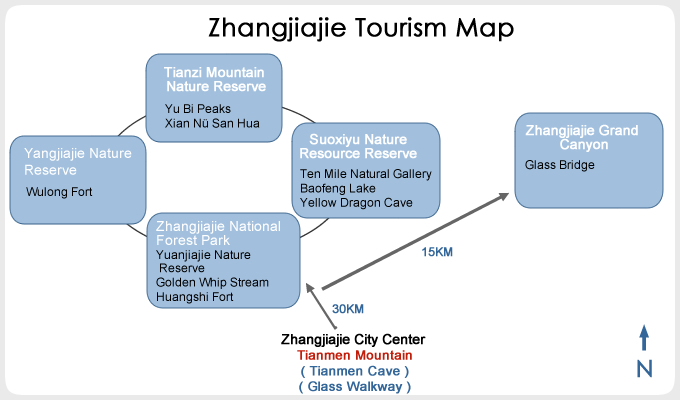
Zhangjiajie is located in the northwest of Hunan Province. The city of Zhangjiajie has two major administrative districts - Yongding District ( downtown area ) and Wulingyuan District (Wulingyuan Scenic Area). Yongding District and Wuling District are approx.30km apart.Wulingyuan Scenic Area was listed as UNESCO World Heritage in 1992. But this world heritage site is popularly known as "Zhangjiajie Scenic Area" rather than "Wulingyuan" mainly because Wulingyuan Scenic Area is under the administration of Zhangjiajie City plus the same name Zhangjiajie National Forest Park within Wulingyuan Scenic Area.
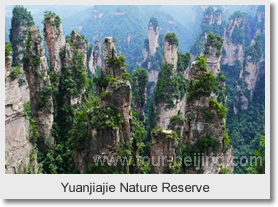
Wulingyuan Scenic Area ( or Zhangjiajie Scenic Area) includes four main areas: Tianzi Mountain Nature Reserve, Yuanjiajie Nature Reserve (Wulong Fort), Yangjiajie Nature Reserve ( including Zhangjiajie National Forest Park,Golden Whip Stream and Haungshi Fort) and Suoxi Valley Natural Resource Reserve (including Ten Mile Natural Gallery, Baofeng Lake,and Yellow Dragon Cave). The American film - Avatar depicted "Hallelujah Mountain" by taking the real view of "South Pillar of the Heaven", a famous attraction in Wulingyuan Scenic Area.
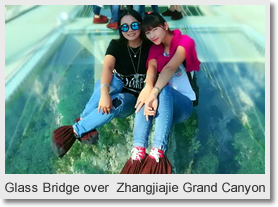
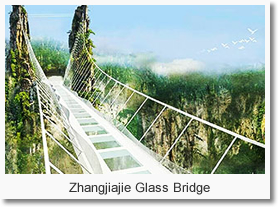
Zhangjiajie Glass Bottom Bridge over Zhangjiajie Grand Canyon. 50 km east of Wulingyuan Scenic Area, Zhangjiajie Grand Canyon is a newly developed tourist destination in Zhangjiajie. Spanning two cliffs in the Zhangjiajie Grand Canyon, the glass bottom bridge stretches 430 meters long and 6 meters wide, hovering over a 300-meter vertical drop.
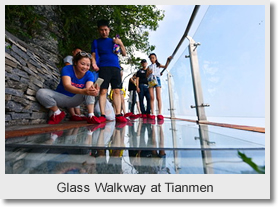
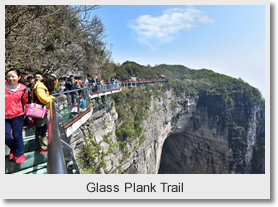
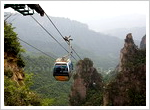
The city of Zhangjiajie (Yongding District) is well known for its Tianmen Mountain. A cable car was designed and built by the French company Poma starting from Zhangjiajie railway station to the top of the mountain. Tianmen Mountain Cableway is claimed as one of the "longest passenger cableway of high mountains in the world", with a total length of 7,455 metres and ascent of 1,279 metres. A 100-meter-long Glass Skywalk clings around a cliff on Tianmen Mountain, attracting a consistent flow of tourists.
Zhangjiajie Tourism Map
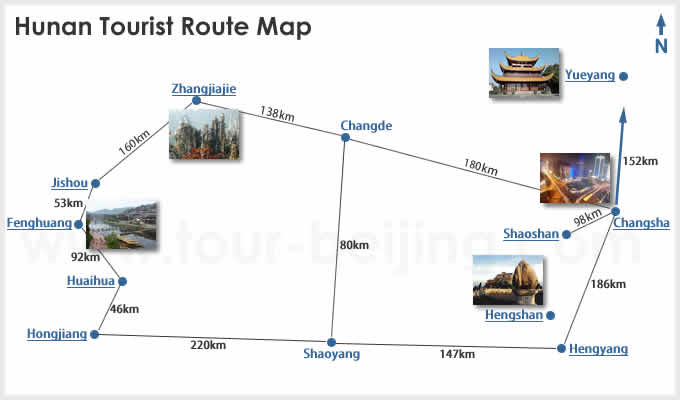
Hunan Tourist Map
Zhangjiajie Guided Tours
|
|||
 |
 Attractions: Tianmen Mountain (Glass Walkway), Tianzi Mountain, Yuanjianjie Nature Reserve, Yangjiajie Nature Reserve, Ten Mile Natural Gallery and the Golden Whip Stream Way of Travel: Private transfer + hotel + air-conditioned vehicle + private tour guides + Entrance fees + Meals as listed Departure Date: Daily ( Choose your own date ) Tour Code: ZJJ-01 Price: Click Here Attractions: Tianmen Mountain (Glass Walkway), Tianzi Mountain, Yuanjianjie Nature Reserve, Yangjiajie Nature Reserve, Ten Mile Natural Gallery and the Golden Whip Stream Way of Travel: Private transfer + hotel + air-conditioned vehicle + private tour guides + Entrance fees + Meals as listed Departure Date: Daily ( Choose your own date ) Tour Code: ZJJ-01 Price: Click Here |
||

|
|||
 |
Attractions: Tianmen Mountain (Glass Walkway), Tianzi Mountain, Yuanjianjie Nature Reserve, Yangjiajie Nature Reserve, Ten Mile Natural Gallery, Jinbian Brook, Baofeng Lake and and Huangshi Fort Way of Travel: Private transfer + hotel + air-conditioned vehicle + private tour guides + Entrance fees + Meals as listed Departure Date: Daily ( Choose your own date ) Tour Code: ZJJ-02 Price: Click Here |
||
|
|||
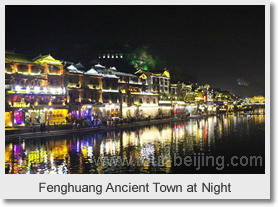 |
Attractions: Tianzi Mountain, Yuanjianjie Nature Reserve,Ten Mile Natural Gallery and the Golden Whip Stream, Tianmen Mountain (Glass Walkway) Fenghuang: Ancient Town, boat cruise in the beautiful Tuo River Way of Travel: Private transfer + private car or van + hotel + private local tour guides + entrance fees + Meals as listed Departure Date: Daily Customizable: Yes! Tour Code: ZJJ-03 Price: Click Here
|
||
|
|||
 |
Attractions: World's Highest Glass Bottom Bridge and Yellow Dragon Cave Way of Travel: Private transfer + air-conditioned vehicle + private tour guides + Entrance fees + Lunch as listed Departure Date: Daily ( Choose your own date ) Tour Code: ZJJ-08 Price: Click Here |
||
|
|||
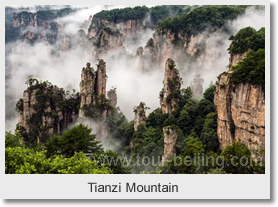 |
Beijing: Great Wall, Tiananmen Square, Forbidden City, Ming Tomb, Summer Palace, Temple of Heaven... Zhangjiajie: Tianzi Mountain, Yuanjianjie Nature Reserve,Ten Mile Natural Gallery and the Golden Whip Stream, Tianmen Mountain (Glass Walkway) Fenghuang: Ancient Town, boat cruise in the beautiful Tuo River Way of Travel: Private transfer + private car or van + hotel + private local tour guides + entrance fees + Meals as listed Departure Date: Daily Customizable: Yes! Tour Code: ZJJ-04 Price: Click Here
|
||
|
|||
 |
Zhangjiajie: Tianzi Mountain, Yuanjianjie Nature Reserve, Ten Mile Natural Gallery and the Golden Whip Stream and Huangshi Fort, Tianmen Mountain (Glass Walkway) Way of Travel: Private transfer + private car or van + hotel + private local tour guides + entrance fees + Meals as listed Departure Date: Daily Customizable: Yes! Tour Code: ZJJ-07 Price: Click Here
|
||
|
|||
 |
Destinations:: Beijing, Xian, Zhangjiajie, Shanghai Duration: 11 Days Tour Type: Small Group Tour Tour Code: SG19 Price: Click Here
|
||
|
|||
 |
Our chauffeur services include airport, railway transfers as well as private drivers to pick you up and drop you off at your various highlights in Zhangjiajie and excursions within Hunan Province. We keep the most competitive prices and use reputable licensed private hire vehicle operators. Zhangjiajie Car Rental with Driver from US$ 75 |
||
Zhangjiajie Travel Information
| Top 10 Attractions in Hunan | Best time to visit Zhangjiajie | Top 10 Attractions in Zhangjiajie | Top 10 Attractions in Changsha |
 |
 |
 |
 |
In summer, the temperature in Zhuangjiajie is comfortable. It is an ideal summer resort for you. It usually rains in June and July, but Zhangjiajie is more beautiful after rain and you can enjoy the cloud and fog spectacle in Tianmen Mountain, West Sea and other parts of Wulingyuan.
Most people think October in autumn are one of the best months to go traveling in Zhangjiajie. At that time, you can enjoy the most beautiful natural sights of Zhangjiajie. Visitors can have a drift in the splendid season.
Winter in Zhangjiajie is not cold with the average temperature of 13℃. In winter, if you are fortunate enough to come across the snow, you will see the different beauty of Zhangjiajie.
Flight: Zhangjiajie airport is located about 4km southwest of Zhangjiajie City and 38km from Wulingyuan Scenic Area Flight: Zhangjiajie airport is located about 4km southwest of Zhangjiajie City and 38km from Wulingyuan Scenic Area (Zhangjiajie Scenic Area). The taxi ride from airport to the Wulingyuan Scenic Area costs about CNY100. Many flights are linked to Beijing, Changsha, Chongqing, Chengdu, Guangzhou and Shanghai.
Train:Zhangjiajie Train Station is located about 10km southeast of the city. There are trains connecting Beijing, Changsha, Guangzhou, Huaihua, Jishou and Yichang. Book the train tickets well in advance.
Long-distance Bus: Zhangjiajie Long-distance Bus Station is on Huilong Road in the city of Zhangjiajie. Daily buses going to and coming from Changsha, Jishou, Fenghua, Shanghai, Wuhan, Xian and Yueyang.
Get around: Zhangjiajie Taxi Fares: RMB4 for the flag-down rate and RMB1.6 per km for each additional kilometer. Zhangjiajie city - Wulingyuan Scenic Area taxi ride: CNY100.
From Zhangjiajie Long-distance Bus Station, there are two bus lines to Wulingyuan Scenic Area - One to the entrance of Tianzi Mountain and the other to the entrance of Suoxi Valley Scenic Area. Bus fare:CNY 10 (40 minutes)
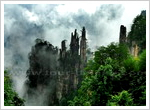
No. 01: Zhangjiajie National Forest Park 张家界国家森林公园
Zhangjiajie National Forest Park is the first national forest park in China, which was recognized in year 1982. It is a unique national forest park as one of the component of Wulingyuan Natural Resort.
No. 02: Tianzi Mountain Nature Reserve 天子山
Bounded by Suoxi Valley on the east ,Zhangjiajie on the south, Sangzhi County on the north, Tianzi Mountain is one of the four scenic zones in Wulingyuan. The landscape in Tianzi Mountain is natural and primeval. People who have climbed Tianzi Mountain will not climb any other mountains.
No. 03: Yangjiajie Nature Reserve 杨家界
Yangjiajie is a newly found dainty nature reserve after Zhangjiajie, Suoxi Valley and Tianzi Mountain which is located in the northwestern part of Zhangjiajie, adjacent to Mountain Tianzi in north.It has absorbed more and more tourist from domestic and other countries.
No. 04: Yuanjiajie 袁家界
Located in the northwest part of the Zhangjiajie National Forest Park, Yuanjiajie is a naturally formed platform mountain, surrounded by higher summits which are divided by deep valleys. Added to this scene is an array of amazing lesser peaks and grotesque rocks.
No. 05: Golden Whip Stream 金鞭溪
The Golden Whip Stream is one of the most attractive travel spot in Zhangjiajie which flows between steep grotesque peaks and luxuriant trees.
No. 06: Ten Mile Natural Gallery 十里画廊
Zhangjiajie Ten-mile Natural Gallery is situated in to the northwest of Suoxigu Natural Reserve, and at the foot of Tianzi Mountain. This natural Chinese painting is about 5.8 kilometers in length. This scenic area is part of Wulingyuan Scenic Area.
No. 07: Suoxi Valley 索溪峪
Suoyi Valley Nature Reserve is connected to Zhangjiajie in southwest and abutted to Tianzi Mountain in northwest contains the sights including Baofeng Lake and Yellow Dragon Cave.
No. 08: Baofeng Lake 宝峰湖
Embraced by continuous mountains, the artificial Baofeng Lake is located in the Suoxiyu Scenic Area in the south of Suoxiyu Town of Zhangjiajie. The Baofeng Lake is filled by streams without pollution. The lake has a fascinating landscape with surrounding mountains and a mid-lake island.
No. 09: Yellow Dragon Cave 黄龙洞
Yellow Dragon Cave was discovered by local villagers in 1983 in Zhangjiajie and opened to tourists in 1984. Some tourists thought of the cave as the most beautiful in China.
No. 10: Tianmen Mountain National Park 天门山
The Tianmen Mountain National Park is a newly developed attraction which is located only 8 kilometers from the city of Zhangjiajie in northwestern Hunan. Tianmen Mountain boasts a primitive forest, numerous rare tree species, medicinal herbs and an abundance of fauna. One of the main attractions of Tianmen Mountain is the Tianmen Cave. It is a natural water-eroded cave with the highest elevation in the world.A 100-meter-long Glass Skywalk clings around a cliff on Tianmen Mountain, attracting a consistent flow of tourists.
No.11: Zhangjiajie Glass Bottom Bridge
Zhangjiajie Glass Bottom Bridge over Zhangjiajie Grand Canyon. 50 km east of Wulingyuan Scenic Area, Zhangjiajie Grand Canyon is a newly developed tourist destination in Zhangjiajie. Spanning two cliffs in the Zhangjiajie Grand Canyon, the glass bottom bridge stretches 430 meters long and 6 meters wide, hovering over a 300-meter vertical drop.
Where to Stay Hotels in Zhangjiajie City
Hotels in Zhangjiajie CityMinnan(GDH) International Hotel: 18 Ziwu Road, Zhangjiajie City Tel: 0744-8228888
Jinjiang Inn: 51 Ziwu Road, Zhangjiajie City Tel: 0744-8398888
Zhongtian International Youth Hostel: 4Ai Zhongtian Building, Ziwu Road, Zhangjiajie City Tel: 0744-8321678
Home Inn (Zhangjiajie Dayongfucheng): Dayongfu Cheng, Tianmen Road, Yongding District, Zhangjiajie
Hotels in Wulingyuan Scenic Area (Zhangjiajie Scenic Area)
Xiang Dian International Hotel: Zhangjiajie National Forest Park, Zhangjiajie Tel: 0744-5712999
Pipaxi Hotel: Zhangjiajie National Forest Park, Zhangjiajie Tel:0744-5718888
Qinghe Jinjiang International Hotel: No.1 Jundi Road, Wulingyuan District, Zhangjiajie
Samantha Resort & Spa: No.8 Baofeng Road, Wulingyuan District, Zhangjiajie
Emperor Hotel: Middle Section of Wuling Road, Wulingyuan District, Zhangjiajie
Jiaotong Hotel: Zhangjiajie National Forest Park, Zhangjiajie Tel: 0744-5718188
Zhangjiajie Pullman Hotel: Huajuan Road, Zhangjiajie
Wulingyuan Hotel: No.192 Wuling Road, Wulingyuan District, Zhangjiajie
As a mountainous city, Zhangjiajie boasts many of local products grown on the mountain, such as kiwi fruit, Qingyan green tea, lobster flower-scented green tea, pine mushrooms and wild arrowroot starch.
Zhangjiajie is well known for Jun Sheng painting, a new kind of style which uses natural materials, like sand, stone, and plants. Zhangjiajie Batik is a traditional folk craftwork in Chinese Tu Minority. The batik is one of the three printing crafts in old China. No matter in villages or stockaded villages of Zhangjiajie, girls learn batik from when they are a child.
The skills often are developed generation after generation. In most Zhangjiajie villages, every family has its own wax knives and dye vats. Tu Minority Brocade is also called Xilankap. It is a absolutely necessary item in Tu Minority daily lives. Tu Minority people can not live without the brocade. Tu Minority brocade can be made into clothes and décor.
Generally speaking, food in Zhangjiajie is characterized by Xiang cuisine, one of China's famed eight cuisines. Most of the dishes are very hot and spicy, sometimes using liquor as an ingredient. The most famous part of this cooking style is the Tujia dishes because of their rich national characteristics, particular materials and unique flavors.
Zhangjiajie Sweet Potato Noodles are made of fresh sweet potato or amylum of the sweet potato. Three Foods in a Pot is a local flavor using intestinal materials from pigs, cows or sheep and cook them in a special pot. Bacon food in Tu Minority is very popular and is easy to make. Not only pork is the maim material of bacon food, but also mutton, pig blood, fish, chicken, duck, beef, pig’s trotter, harslet, bean curd and so on.
Zhangjiajie nightlife is different from the nightlife of big cities. At night, the streets of Zhangjiajie are full of vendors selling barbecue and local snacks. Zhangjiajie has bars, foot massages, karaoke, bars, dance halls and so on.
The many folk customs are so attractive. These unique and interesting shows can be found in theaters of Zhangjiajie such as Mei Li Xiang Xi and Zhang Jia Jie Theater and others places such as Tujia Folk Village.
Useful Phone Numbers in Zhangjiajie
Zhangjiajie City Tourism Bureau: 0744-8380188Public Security Bureau: 0744-8222151
Wulinhyuan Scenic Area: 0744-5618109
Zhangjiajie Airport Office: 0744-8238211
Zhangjiajie Airport Inquiry: 0744-8238417
Zhangjiajie Railway Inquiry: 0744-8514442
Zhangjiajie People's Hospital: 0744-8222270
Questions & Answers:
 Here is only for Questions and Answers. ( For anyone who wants to have an enquiry or customized tour, please email us to
  . )
. )