



Shanhua Temple in Datong
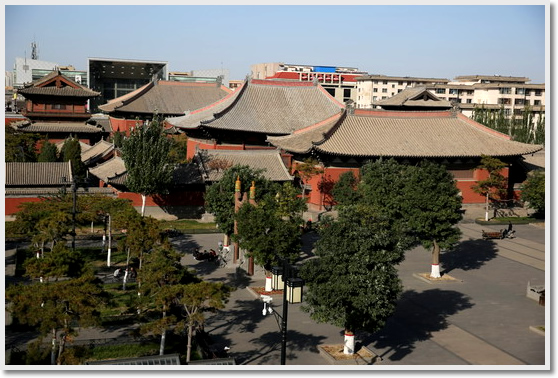
Also named Southern Temple as it lies the south gate of Datong City in Shanxi Province. Shanhua Temple was originally founded during the Tang Dynasty (618-907) but it was destroyed by war at the end of the Liao Dynasty (916-1125). During the Jin Dynasty (1115-1234) it was rebuilt on a large scale. It has been preserved well until now.
Occupying an area of over 15,000 square meters, the main structures of the temple are: the Temple Gate, the Three-Sage Hall, and the most important building, Great Hall--Da Xiong Bao Dian in Chinese Words (‘Da’ means ‘including everything’; ‘Xiong’ means ‘vanquishing and taming demons’; ‘Bao’ refers to the three treasures of this religion: Buddha, the Buddhist doctrines and the Buddhist monks; ‘Dian’ means ‘a palace’)
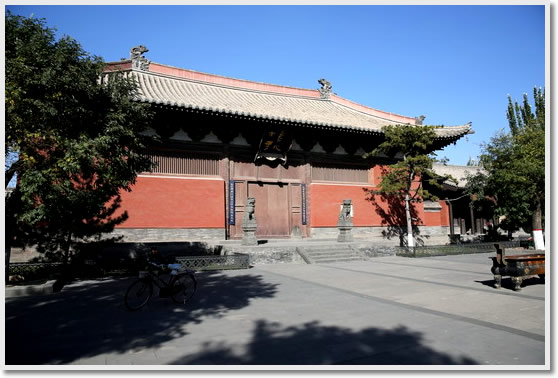
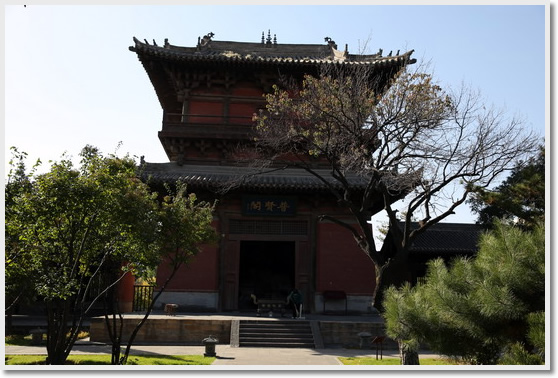
The temple gate is also named Heaven God Hall in the front of Shanhua Temple. A pair of stone lions is standing on a platform in the front of the gate In the left and right side-rooms there are the statues of the Four Heaven Guardians, which look majestic and furious. The temple gate is the biggest extant temple gate of the Jin Dynasty.
The Three-Sage Hall is a typical of Jin arch building and spacious with 5-bay wide, 4-bay deep. It has a single-eaved roof and the arch under the eaves is majestic. The hall represents statues of Sakyamuni, Bodhisattva Puxian and Bodhisattva Wenshu.
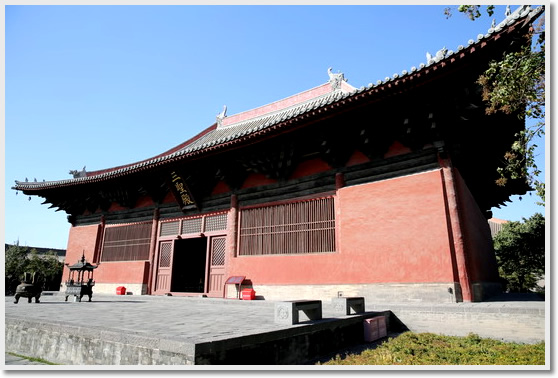
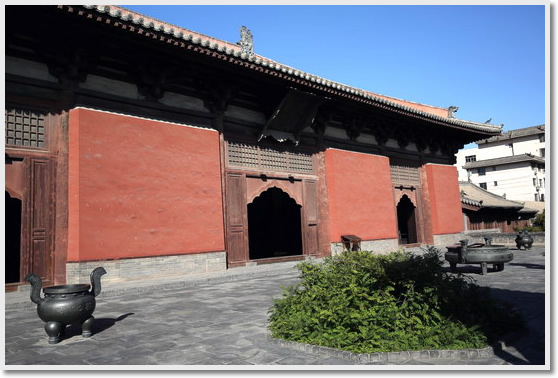
Da Xiong Bao Dian is the biggest hall in Shanhua Temple and typical of Lao architecture. The hall is 7-bay wide, 5-bay deep and have a single-eaved roof with 5 ridges added a platform in the front, and Bell and Drum tower on the both sides. In Da Xion Bao Dian reside five gold-coated statures of Tathagata Buddha, named Wu Fang Fo, which are original statues from the Jin Dynasty.
On the eastern and western sides of these five statures, there are 24 gods, beautifully and realistically shaped. Among them, the God of the Sun’s Palace and the God of the Moon’s Palace are artistic masterpieces from the Jin Dynasty. There is one palace on each side of the Da Xiong Bao Dian. One is the palace of Bodhisattva Puxian and the other is the palace ruins of Bodhisattva Wenshu.
The temple seems very spiritual and solemn. Only a Five-Dragon Screen from a colored glaze adds a trace of cheerful atmosphere Ticket Price: RMB20
Questions & Answers:
 Here is only for Questions and Answers. ( For anyone who wants to have an enquiry or customized tour, please email us to
  . )
. )