


Xinjiang Trip
Changji Trip
Burjin Trip
Kanas Trip
Kelamayi Trip
Urumqi Trip
Turpan Trip
Southern Xinjiang Trip
Luntai Trip
Kuqa Trip
Aksu Trip
Artux Trip
Kashgar Trip
Kizilsu Trip

Changji Trip
Burjin Trip
Kanas Trip
Kelamayi Trip
Urumqi Trip
Turpan Trip
Southern Xinjiang Trip
Luntai Trip
Kuqa Trip
Aksu Trip
Artux Trip
Kashgar Trip
Kizilsu Trip

Silk Road Travel Guide
Top Attractions on the Silk Road
Silk Road Travel Tips
Xian Travel Guide
Tianshui Travel Guide
Lanzhou Travel Guide
Xiahe Travel Guide
Wuwei Travel Guide
Zhangye Travel Guide
Jiayuguan Travel Guide
Dunhuang Travel Guide
Turpan Travel Guide
Urumqi Travel Guide
Fuyun Travel Guide
Altay Travel Guide
Altay Travel Guide
Burjin Travel Guide
Karamy Travel Guide
Bole Travel Guide
Yining Travel Guide
Bayanbulak Travel Guide
Korla Travel Guide
Luntai Travel Guide
Kuqa Travel Guide
Aksu Travel Guide
Kashgar Travel Guide
Artux Travel Guide
Tashkurgan Travel Guide
Yarkan Travel Guide
Hotan Travel Guide
Mingfeng Travel Guide
Xining Travel Guide
Yinchuan Travel Guide
Zhongwei Travel Guide
Silk Road Travel Tips
Xian Travel Guide
Tianshui Travel Guide
Lanzhou Travel Guide
Xiahe Travel Guide
Wuwei Travel Guide
Zhangye Travel Guide
Jiayuguan Travel Guide
Dunhuang Travel Guide
Turpan Travel Guide
Urumqi Travel Guide
Fuyun Travel Guide
Altay Travel Guide
Altay Travel Guide
Burjin Travel Guide
Karamy Travel Guide
Bole Travel Guide
Yining Travel Guide
Bayanbulak Travel Guide
Korla Travel Guide
Luntai Travel Guide
Kuqa Travel Guide
Aksu Travel Guide
Kashgar Travel Guide
Artux Travel Guide
Tashkurgan Travel Guide
Yarkan Travel Guide
Hotan Travel Guide
Mingfeng Travel Guide
Xining Travel Guide
Yinchuan Travel Guide
Zhongwei Travel Guide
Beijing Tour
Xian Tour
Shanghai Tour
Guilin Tour
Datong Tour
Chengde Tour
Chengdu Tour
Chongqing Tour
Hong Kong Tour
Luoyang Tour
Lijiang Tour
Pingyao Tour
Inner Mongolia Tour
Harbin Tour
Hangzhou Tour
Huangshan Tour
Tianjin Tour
Qufu Tour
Mt.Taishan Tour
Jinan Tour
Qingdao Tour
Qinhuangdao Tour
Jiuzhaigou Tour
Zhangjiajie Tour
Xian Tour
Shanghai Tour
Guilin Tour
Datong Tour
Chengde Tour
Chengdu Tour
Chongqing Tour
Hong Kong Tour
Luoyang Tour
Lijiang Tour
Pingyao Tour
Inner Mongolia Tour
Harbin Tour
Hangzhou Tour
Huangshan Tour
Tianjin Tour
Qufu Tour
Mt.Taishan Tour
Jinan Tour
Qingdao Tour
Qinhuangdao Tour
Jiuzhaigou Tour
Zhangjiajie Tour
China Province Tour
Tibet Tour
Shandong Tour
Guangdong Tour
Fujian Tour
Qinghai Tour
Ninxia Tour
Guizhou Tour
Inner Mongolia Tour
Shandong Tour
Guangdong Tour
Fujian Tour
Qinghai Tour
Ninxia Tour
Guizhou Tour
Inner Mongolia Tour
Beijing Trip
Xian Trip
Shanghai Trip
Guilin Trip
Chengdu Trip
Chengde Trip
Inner Mongolia Trip
Datong Trip
Harbin Trip
Pingyao Trip
Luoyang Trip
Qufu Trip
Shangdong Trip
Hangzhou Trip
Lhasa Trip
Yangtze River Trip
Huangshan Trip
Xian Trip
Shanghai Trip
Guilin Trip
Chengdu Trip
Chengde Trip
Inner Mongolia Trip
Datong Trip
Harbin Trip
Pingyao Trip
Luoyang Trip
Qufu Trip
Shangdong Trip
Hangzhou Trip
Lhasa Trip
Yangtze River Trip
Huangshan Trip
- - - - - - - - - - - - - - - - - - - -
Beijing Travel Service
China Travel Agency
Beijing Travel Tips
Beijing Information
Beijing Travel Service
China Travel Agency
Beijing Travel Tips
Beijing Information
Home → China Tours → Silk Road Tours → Zhongwei Travel Guide
Zhongwei Travel Guide
Location: Zhongwei is in the Midwest part of Ningxia Hui Autonomous Area, on the crossing of Ningxia, Gansu, and Inner Mongolia.
Population: 1,041,821
Area: 16,986 sq km
Nationalities: Hui, Han, Inner Mongolia
History: Zhongwei has a long period of history traced bake to 30,000 years ago. In Spring and Autumn Age, Qiang and Rong nationalities resided here motleyly. After Qin Country combined the other six countries, Zhongwei was merged into the whole territory. From of old, Zhongwei was the town of battle.
Climate: The climate in Zhongwei features dry, strong-wind, sandy, and more sandstorm.
Transportation: Zhongwei has convenient communication. Xiangshan Airport scheduled flights to Beijing, Chongqing, Xian and so on at present.
Bao-Zhong railroad lines go through Zhongwei. Zhongwei is also a central railway station connecting the Northwest and the East. Trains bound for Beijng, Shanghai, Xining, Xian, etc.
As a transportation junction, Zhongwei not only plays an important role in the communication in Ningxia, but also enjoys an immovable place in the whole northwest region. Three state highways, GZ25、GZ35、GZ45, going through Zhongwei link up Xinjiang, Hexi Corridor and the eastern regions, and form an east-west transportation network that connects Zhongwei and its surrounding regions. While Yining highway, Zhongjing highway, 109 state highway, and Zhonghao expressway are also transportation ties joining Zhongwei and other areas.
Local Specialties: Xiangshui Pear, Bitter Buchwheat, Seabuckthorn, Yellow Wine
Local Food: Braised Beef in Brown Sauce, Hand pulled Saozi Noodles, Steamed Northern bronze gudgeon, Sauted Camel Hoof, Fried Tofu with Vegetable, Yanmianrourou (a kind of naked oats made snack)
Major Attractions:
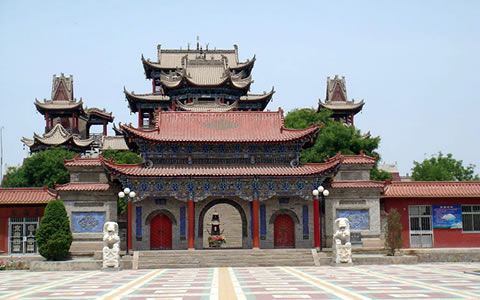
Gao Temple - The temple was originally built in the early Ming Dynasty (1368-1644 AD). The present temple is a magnificent jumble of buildings and styles covering an area of about four thousand square meters. The temple is a structure that, like the Hanging Monastery near Datong, caters mainly to the three religions of Buddhism, Confucianism and Taoism (although the temple even goes so far as to celebrate Christianity and other religions that have tried to find their home in China). Statues of the Gautama Buddha, the Jade Emperor and the Holy Mother can still be seen here, under the roofs of the 250 temple rooms that make up the complex.
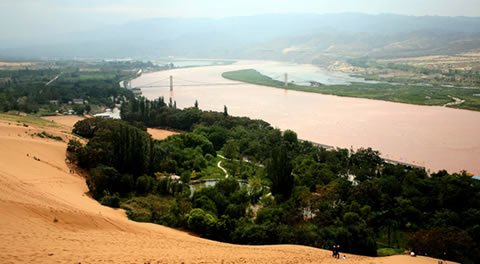
Shapotou - Shapotou Scenic Zone, 22 km west of Zhongwei County, is characterized by a cliff-like sand dune some 70 metres in height and 200 metres in width. It is also a landmark for the lTengger Desert. "Bell tolls at the Sandy Slope" is a famed scenery. The local people have managed to harness the desert by planting grass in chessboard pattern. Travellers may venture into the Tengger Desert by riding camels, or raft the Yellow River aboard sheepskin dinghies.
Travel Tips:
1. Zhongwei is located deeply in the inland China close to desert and so far away from the sea, hence, the weather features late spring, short summer and long winter. It is windy and there is lack of rain in this area. May to October may be the best time to visit here.
Here is only for Questions and Answers. ( For anyone who wants to have an enquiry or tour booking, please fill in our Online Enquiry. )
Zhongwei Travel Guide
Location: Zhongwei is in the Midwest part of Ningxia Hui Autonomous Area, on the crossing of Ningxia, Gansu, and Inner Mongolia.
Population: 1,041,821
Area: 16,986 sq km
Nationalities: Hui, Han, Inner Mongolia
History: Zhongwei has a long period of history traced bake to 30,000 years ago. In Spring and Autumn Age, Qiang and Rong nationalities resided here motleyly. After Qin Country combined the other six countries, Zhongwei was merged into the whole territory. From of old, Zhongwei was the town of battle.
Climate: The climate in Zhongwei features dry, strong-wind, sandy, and more sandstorm.
Transportation: Zhongwei has convenient communication. Xiangshan Airport scheduled flights to Beijing, Chongqing, Xian and so on at present.
Bao-Zhong railroad lines go through Zhongwei. Zhongwei is also a central railway station connecting the Northwest and the East. Trains bound for Beijng, Shanghai, Xining, Xian, etc.
As a transportation junction, Zhongwei not only plays an important role in the communication in Ningxia, but also enjoys an immovable place in the whole northwest region. Three state highways, GZ25、GZ35、GZ45, going through Zhongwei link up Xinjiang, Hexi Corridor and the eastern regions, and form an east-west transportation network that connects Zhongwei and its surrounding regions. While Yining highway, Zhongjing highway, 109 state highway, and Zhonghao expressway are also transportation ties joining Zhongwei and other areas.
Local Specialties: Xiangshui Pear, Bitter Buchwheat, Seabuckthorn, Yellow Wine
Local Food: Braised Beef in Brown Sauce, Hand pulled Saozi Noodles, Steamed Northern bronze gudgeon, Sauted Camel Hoof, Fried Tofu with Vegetable, Yanmianrourou (a kind of naked oats made snack)
Major Attractions:
Gao Temple - The temple was originally built in the early Ming Dynasty (1368-1644 AD). The present temple is a magnificent jumble of buildings and styles covering an area of about four thousand square meters. The temple is a structure that, like the Hanging Monastery near Datong, caters mainly to the three religions of Buddhism, Confucianism and Taoism (although the temple even goes so far as to celebrate Christianity and other religions that have tried to find their home in China). Statues of the Gautama Buddha, the Jade Emperor and the Holy Mother can still be seen here, under the roofs of the 250 temple rooms that make up the complex.

Shapotou - Shapotou Scenic Zone, 22 km west of Zhongwei County, is characterized by a cliff-like sand dune some 70 metres in height and 200 metres in width. It is also a landmark for the lTengger Desert. "Bell tolls at the Sandy Slope" is a famed scenery. The local people have managed to harness the desert by planting grass in chessboard pattern. Travellers may venture into the Tengger Desert by riding camels, or raft the Yellow River aboard sheepskin dinghies.
Travel Tips:
1. Zhongwei is located deeply in the inland China close to desert and so far away from the sea, hence, the weather features late spring, short summer and long winter. It is windy and there is lack of rain in this area. May to October may be the best time to visit here.
| Questions & Answers: |