


Xinjiang Trip
Changji Trip
Burjin Trip
Kanas Trip
Kelamayi Trip
Urumqi Trip
Turpan Trip
Southern Xinjiang Trip
Luntai Trip
Kuqa Trip
Aksu Trip
Artux Trip
Kashgar Trip
Kizilsu Trip

Changji Trip
Burjin Trip
Kanas Trip
Kelamayi Trip
Urumqi Trip
Turpan Trip
Southern Xinjiang Trip
Luntai Trip
Kuqa Trip
Aksu Trip
Artux Trip
Kashgar Trip
Kizilsu Trip

Silk Road Travel Guide
Top Attractions on the Silk Road
Silk Road Travel Tips
Xian Travel Guide
Tianshui Travel Guide
Lanzhou Travel Guide
Xiahe Travel Guide
Wuwei Travel Guide
Zhangye Travel Guide
Jiayuguan Travel Guide
Dunhuang Travel Guide
Turpan Travel Guide
Urumqi Travel Guide
Fuyun Travel Guide
Altay Travel Guide
Altay Travel Guide
Burjin Travel Guide
Karamy Travel Guide
Bole Travel Guide
Yining Travel Guide
Bayanbulak Travel Guide
Korla Travel Guide
Luntai Travel Guide
Kuqa Travel Guide
Aksu Travel Guide
Kashgar Travel Guide
Artux Travel Guide
Tashkurgan Travel Guide
Yarkan Travel Guide
Hotan Travel Guide
Mingfeng Travel Guide
Xining Travel Guide
Yinchuan Travel Guide
Zhongwei Travel Guide
Silk Road Travel Tips
Xian Travel Guide
Tianshui Travel Guide
Lanzhou Travel Guide
Xiahe Travel Guide
Wuwei Travel Guide
Zhangye Travel Guide
Jiayuguan Travel Guide
Dunhuang Travel Guide
Turpan Travel Guide
Urumqi Travel Guide
Fuyun Travel Guide
Altay Travel Guide
Altay Travel Guide
Burjin Travel Guide
Karamy Travel Guide
Bole Travel Guide
Yining Travel Guide
Bayanbulak Travel Guide
Korla Travel Guide
Luntai Travel Guide
Kuqa Travel Guide
Aksu Travel Guide
Kashgar Travel Guide
Artux Travel Guide
Tashkurgan Travel Guide
Yarkan Travel Guide
Hotan Travel Guide
Mingfeng Travel Guide
Xining Travel Guide
Yinchuan Travel Guide
Zhongwei Travel Guide
Beijing Tour
Xian Tour
Shanghai Tour
Guilin Tour
Datong Tour
Chengde Tour
Chengdu Tour
Chongqing Tour
Hong Kong Tour
Luoyang Tour
Lijiang Tour
Pingyao Tour
Inner Mongolia Tour
Harbin Tour
Hangzhou Tour
Huangshan Tour
Tianjin Tour
Qufu Tour
Mt.Taishan Tour
Jinan Tour
Qingdao Tour
Qinhuangdao Tour
Jiuzhaigou Tour
Zhangjiajie Tour
Xian Tour
Shanghai Tour
Guilin Tour
Datong Tour
Chengde Tour
Chengdu Tour
Chongqing Tour
Hong Kong Tour
Luoyang Tour
Lijiang Tour
Pingyao Tour
Inner Mongolia Tour
Harbin Tour
Hangzhou Tour
Huangshan Tour
Tianjin Tour
Qufu Tour
Mt.Taishan Tour
Jinan Tour
Qingdao Tour
Qinhuangdao Tour
Jiuzhaigou Tour
Zhangjiajie Tour
China Province Tour
Tibet Tour
Shandong Tour
Guangdong Tour
Fujian Tour
Qinghai Tour
Ninxia Tour
Guizhou Tour
Inner Mongolia Tour
Shandong Tour
Guangdong Tour
Fujian Tour
Qinghai Tour
Ninxia Tour
Guizhou Tour
Inner Mongolia Tour
Beijing Trip
Xian Trip
Shanghai Trip
Guilin Trip
Chengdu Trip
Chengde Trip
Inner Mongolia Trip
Datong Trip
Harbin Trip
Pingyao Trip
Luoyang Trip
Qufu Trip
Shangdong Trip
Hangzhou Trip
Lhasa Trip
Yangtze River Trip
Huangshan Trip
Xian Trip
Shanghai Trip
Guilin Trip
Chengdu Trip
Chengde Trip
Inner Mongolia Trip
Datong Trip
Harbin Trip
Pingyao Trip
Luoyang Trip
Qufu Trip
Shangdong Trip
Hangzhou Trip
Lhasa Trip
Yangtze River Trip
Huangshan Trip
- - - - - - - - - - - - - - - - - - - -
Beijing Travel Service
China Travel Agency
Beijing Travel Tips
Beijing Information
Beijing Travel Service
China Travel Agency
Beijing Travel Tips
Beijing Information
Home → China Tours → Silk Road Tours → Tianshui Travel Guide
Tianshui Travel Guide
Location: As one of the essential points on Silk Road, Tianshui city is in the southeast of Gansu Province. It is close with Maijishan Grottoes and cross through Changjiang River and Yellow River.
Population: As the second largest city in Gansu Province, its population is approximately 3,500,000.
Area: Tianshui City, the existing total area of 589.91 hectares of forest, the forest coverage rate to 26.5 percent. Natural forest is mainly distributed in the east, south-east of Long Hill, West Qinling and Guanshan Lin.
Nationalities: Tishui City is distributed by many nationalities, a total of 32. The number of minority occupies 6.9% of the whole population。Hui minority nationality has the largest population, and the others are Manchu, Mongolia as well as Zang minority nationality. Tianshui city is a diocese of the Roman Catholic church.
Hitory: Tianshui is a state-level historical city. This region has been inhabited since Neolithic time, excavated relics has a history of 8120 years. It is the birthplace of Fuxi, the earliest Chinese ancestor. The Qin State, later to become the founding dynasty of the Chinese empire, grew out from this area.
Climate: The place enjoys a temperate climate with well-marked seasons. The annual average temperature is 11.5℃. The hottest temperature is 33.4℃ in July and the coldest in January.
Transportation: Tianshui enjoys a convenient transport. The airline was newly opened, the scheduled flights leading to all major cities in China. The national highway G312 from Lianyungang in the east of Jiangsu Province to Huo’erguosi Port in Xinjiang Province, passes Tianshui. It takes about 4 hours from Lanzhou to Tianshui by train. The railway station offers trains to more than 10 cities such as Beijing, Shijiazhuang, Qingdao, Tianshui, etc.
Local Specialties: Tianshui has been an important distribution center for goods and materials in the southeast of Gansu Province since ancient times, highly reputed as “West China Textile City” and “Electric Equipment Centre”. It is a famous-producing city, producing good-quality and tasteful Huaniu apples, good juicy peach, sweet almond, cantaloupe and watermelon. What’s more, handcrafts like jade carvings, carpets, silk tapestries are famous at home and abroad.
Local Food: With wheat and corn as the main crops, Tianshui food is mainly made from flaour. Tianshui food is noted for its delicious Guagua, Liangpi, Jiangshui Noodle, Jiaotuan and Dalu Noodle and so on.
Major Attractions
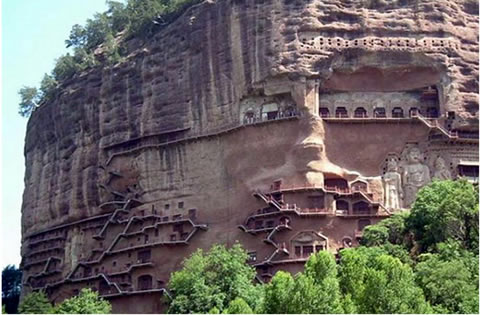
Maijishan Grottoes – As one of the four famous Grottoes in China with other three being Yungang Grottoes in Datong, Longmen Grottoes in Luoyang and Mogao Grottoes in Dunhuang, the Maijingshan Grottoes are a series of 194 caves cut in the side of the hill Maijishan. This rock cut architecture contains over 7,200 Buddhist sculptures and over 1,000 square meters of murals, all of which built from 384AD to the Qin Dynasty (1644-1911).
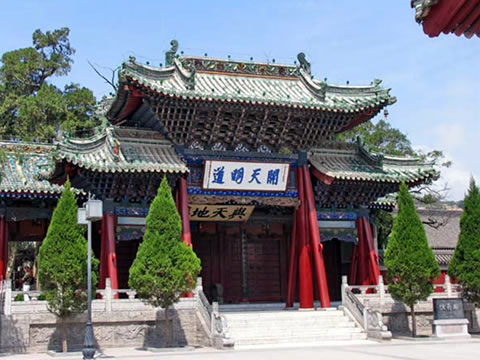
Fuxi Temple – Fuxi Temple was built to commemorate Fuxi, who was the earliest ancestors of ancient China. The temple is a Ming Dynasty construction that, despite renovations in the Qing Dynasty, still retains its Ming format. Every year on January 15th (alleged birthday of the emperor) and May 13th (apparent birthday of China’s first dragon) by the Chinese traditional calendar, grand sacrificial ceremonies are held, which draw throngs of Chinese and foreigners to its door.
Travel Tips:
1. as most Chinese towns sell them at streetside newsagents or in bookstores, the only English Language maps of the area are to be found in the gift shop at the China Post Hotel (just northwest of the main square).
2. The Fuxi Temple is easily accessible if you are in the downtown area of Tianshui-simply walk down the street south of Central Square. Temple admission is free from the first day to the seventh day of the first lunar month.
Here is only for Questions and Answers. ( For anyone who wants to have an enquiry or tour booking, please fill in our Online Enquiry. )
Tianshui Travel Guide
Location: As one of the essential points on Silk Road, Tianshui city is in the southeast of Gansu Province. It is close with Maijishan Grottoes and cross through Changjiang River and Yellow River.
Population: As the second largest city in Gansu Province, its population is approximately 3,500,000.
Area: Tianshui City, the existing total area of 589.91 hectares of forest, the forest coverage rate to 26.5 percent. Natural forest is mainly distributed in the east, south-east of Long Hill, West Qinling and Guanshan Lin.
Nationalities: Tishui City is distributed by many nationalities, a total of 32. The number of minority occupies 6.9% of the whole population。Hui minority nationality has the largest population, and the others are Manchu, Mongolia as well as Zang minority nationality. Tianshui city is a diocese of the Roman Catholic church.
Hitory: Tianshui is a state-level historical city. This region has been inhabited since Neolithic time, excavated relics has a history of 8120 years. It is the birthplace of Fuxi, the earliest Chinese ancestor. The Qin State, later to become the founding dynasty of the Chinese empire, grew out from this area.
Climate: The place enjoys a temperate climate with well-marked seasons. The annual average temperature is 11.5℃. The hottest temperature is 33.4℃ in July and the coldest in January.
Transportation: Tianshui enjoys a convenient transport. The airline was newly opened, the scheduled flights leading to all major cities in China. The national highway G312 from Lianyungang in the east of Jiangsu Province to Huo’erguosi Port in Xinjiang Province, passes Tianshui. It takes about 4 hours from Lanzhou to Tianshui by train. The railway station offers trains to more than 10 cities such as Beijing, Shijiazhuang, Qingdao, Tianshui, etc.
Local Specialties: Tianshui has been an important distribution center for goods and materials in the southeast of Gansu Province since ancient times, highly reputed as “West China Textile City” and “Electric Equipment Centre”. It is a famous-producing city, producing good-quality and tasteful Huaniu apples, good juicy peach, sweet almond, cantaloupe and watermelon. What’s more, handcrafts like jade carvings, carpets, silk tapestries are famous at home and abroad.
Local Food: With wheat and corn as the main crops, Tianshui food is mainly made from flaour. Tianshui food is noted for its delicious Guagua, Liangpi, Jiangshui Noodle, Jiaotuan and Dalu Noodle and so on.
Major Attractions
Maijishan Grottoes – As one of the four famous Grottoes in China with other three being Yungang Grottoes in Datong, Longmen Grottoes in Luoyang and Mogao Grottoes in Dunhuang, the Maijingshan Grottoes are a series of 194 caves cut in the side of the hill Maijishan. This rock cut architecture contains over 7,200 Buddhist sculptures and over 1,000 square meters of murals, all of which built from 384AD to the Qin Dynasty (1644-1911).

Fuxi Temple – Fuxi Temple was built to commemorate Fuxi, who was the earliest ancestors of ancient China. The temple is a Ming Dynasty construction that, despite renovations in the Qing Dynasty, still retains its Ming format. Every year on January 15th (alleged birthday of the emperor) and May 13th (apparent birthday of China’s first dragon) by the Chinese traditional calendar, grand sacrificial ceremonies are held, which draw throngs of Chinese and foreigners to its door.

Travel Tips:
1. as most Chinese towns sell them at streetside newsagents or in bookstores, the only English Language maps of the area are to be found in the gift shop at the China Post Hotel (just northwest of the main square).
2. The Fuxi Temple is easily accessible if you are in the downtown area of Tianshui-simply walk down the street south of Central Square. Temple admission is free from the first day to the seventh day of the first lunar month.
| Questions & Answers: |