
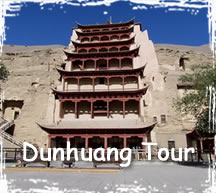


Dunhuang Travel Guide
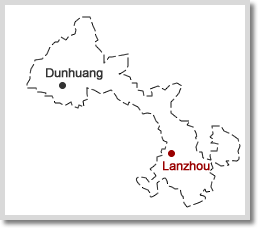 Location: Situated in an oasis, Dunhuang (敦煌) is in the west end of Hexi Corridor and the junction of Gansu, Qinghai and Qinghai.
Population: 150,000
Area: with an area of 312,000 square kilometers
Nationalities: Han, Hui, Mongolia, Tibet, Uigur, Kazakstan, Tujia, Dongxiang and Yugu nationalities.
History: Dunhuang was made by a prefecture in 117BC by Emperor Han Wudi, and was a major point of interchange between ancient China and Central Asia during the Han and Tang dynasties. Its name is mentioned as part of the homeland of the Yuezhi or Rouzhi in the Shiji, Dunhuang is a safe place for traders to cross. Early Buddhist monks accessed Dunhuang and collected scriptures from the east for centuries.
Climate: Dunhuang has arid, continental climate. The annual temperature is 9.3℃, but ranges from 24.7℃ in July to -9.3℃ in January. It is fervent in summer and bitterly cold in winter. The annual average rainfall is 39.9mm and the free-frost period keeps for 144 days per year.
Transportation: Air- Dunhuang Airport is 13kms east of the downtown and operates regular flights to Lanzhou, Xian Beijing, Jiayuguan, Urumqi, etc.
Railway- Dunhuang has two railway stations such as station and Duhuang station. There are trains to Beijing, Shanghai, Xian, Chengdu, Lanzhou, Urumqi and so on
Highway- There are passenger buses heading for Jiuquan, Lanzhou, Xian, Hami, Turpan, Urumqi, Geermu, etc
Specialties: Crystal stone, crystal jewelry, white jade camel, Silky carpet of Dunhuang, statues, ectype of fresco, luminous cup, etc.
Local Food: Pastry Noodles. Stuffing Pie, Shish Kebab, Liguang Apricot, Mingshan Big Date, Ziyangpeach, Fragrant Pear, Limpid Grapes, and Yellow River Cantaloup
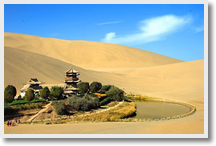 Dunhuang Attractions |
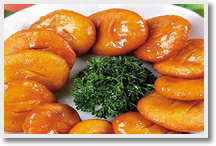 Dunhuang Dining |
 Dunhuang Shopping |
 Dunhuang Transportation |
 Dunhuang Nightlife |
 Dunhuang Climate |
Questions & Answers:
 Here is only for Questions and Answers. ( For anyone who wants to have an enquiry or customized tour, please email us to
  . )
. )