



Beijing Railway Stations
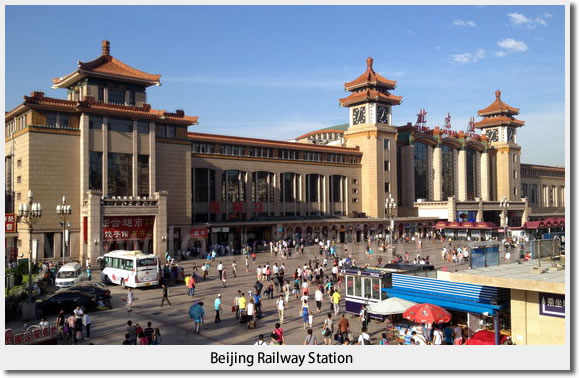
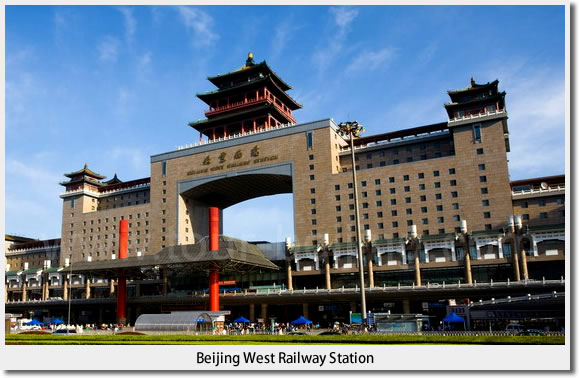
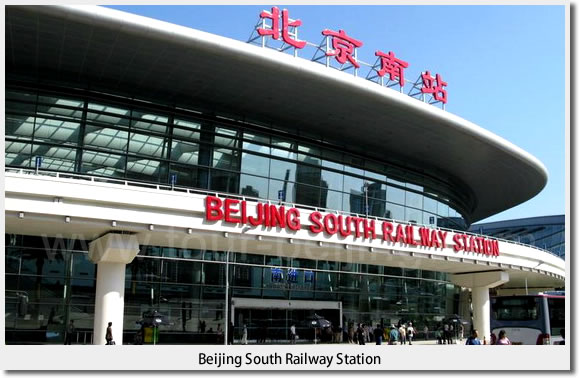
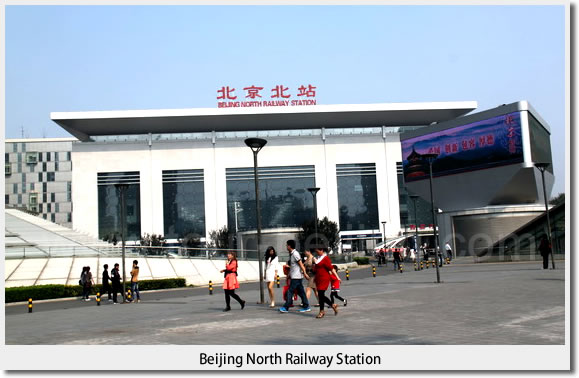
Start your China train tour from Beijing? There are four major railway stations in Beijing, namely, Beijing Railway Station (To Datong...), Beijing South Railway Station (Highspeed trains to Shanghai...), Beijing West Railway Station (to Xian...) and Beijing North Railway Station (to Badaling Great Wall...). If you get to Beijing or you are leaving from Beijing by train, make sure you are on the right train station. 
Beijing Railway Station ( Beijing )
Add: Beijing Zhan Jie, Dongcheng District ( centrally located just south of Beijing International Hotel) Tel: 51019999The trains departing from Beijing Railway Station: Datong, Chengde, Hohhot, Harbin, Shenyang, Dalian, Qingdao, Jinan, Shanghai, Nanjing Hangzhou and other cities from this station. Some international lines ( namely the railway line linking Beijing to Pyongyang, North Korea (DPRK), amongst others), also depart from this station.
1.Beijing Capital Airport - Beijing Railway Station Transportation
1) Airport Shuttle Bus No.03 connects Capital Airport and Beijing Railway Station
2) Airport Express Train + Subway: Take airport express train and get off at its final station of Dongzhimen (东直门), interchange for Subway line 2 to the south and alight at the third stop of Beijing Railway Station (北京站), exit from Exit C or D.
3) Taxi fare: about RMB 90 ( 28km ).
2. Get there and away
To leave or go to Beijing Railway Station, taking subway is the most convenient way of public transportation since the subway line 2 passes by the train station square in the north. The Subway station has four exits: Exit C and D for exiting and Exit A and B for entering. With subway line 2, you are linked to other three train station: Beijing South Railway Station ( line 4), Beijing West Railway Station ( line 9 ) and Beijing North Railway Station ( line 2 and 4 ). Check Beijing Subway Map for more information.
3. Cafe and Restaurants
There are some clean and quality cafes and restautants available at Beijing Railway Station like KFC.
Beijing West Railway Station ( Beijing West )
Add: Lianhuachi Donglu, Fengtai District ( just south of Military Museum of the Chinese People's Revolution)Tel: 51826253The trains departing from Beijing West Railway Station: Xian, Luoyang, Chongqing, Chengdu, Lhasa, Urumqi, Guangzhou and Kowloon.
1.Beijing Capital Airport - Beijing West Railway Station Transportation
1) No.07: Capital Airport - Beijing West Train Station connects Capital Airport and Beijing West Railway Station
2) Airport Express Train + Subway: Take airport express train and get off at its final station of Dongzhimen (东直门), interchange for Subway line 2 to the south and alight at the second stop of Chaoyangmen (朝阳门), again interchange for subway line 6 to the west and alight at 7th station of Baishiqiao South (白石桥南), then again interchange for Subway Line 9 to the south direction and get off at the second station of Beijing West Railway Station (北京西站)and start your train travel.
3) Taxi fare: about RMB 130( 40km ).
2. Get there and away
To leave or go to Beijing West Railway Station, taking subway is the most convenient way of public transportation since the subway line 9 passes by the train station. With subway line 9, you are linked to other three train station: Beijing Railway Station ( line 2), Beijing South Railway Station ( line 4 ) and Beijing North Railway Station ( line 2 and 4 ). Check Beijing Subway Map for more information.
3. Cafe and Restaurants
There are some clean and quality cafes and restautants available at Beijing Railway Station like KFC.
Add: Yongdingmenwai Dajie, Dongcheng District ( just south of the southern second ring road) Tel: 51867999
The trains departing from Beijing South Railway Station: serving as the terminus for high-speed trains to Tianjin, Jinan, Shanghai, Qingdao and other cities.
1.Beijing Capital Airport - Beijing South Railway Station Transportation
1) No 10: Capital Airport - Beijing South Railway Station connects Capital Airport and Beijing South Railway Station
2) Airport Express Train + Subway: Take airport express train and get off at its final station of Dongzhimen (东直门), interchange for Subway line 2 to the south and alight at the 7th station of Xuanwumen (宣武门), then interchange for subway line 4 to the south and alight at the third station of Beijing South Railway Station (北京南站) and start your train travel.
3) Taxi fare: about RMB 130( 40km ).
2. Get there and away
To leave or go to Beijing South Railway Station, taking subway is the most convenient way of public transportation since the subway line 4 passes by the train station. With subway line 4, you are linked to other three train station: Beijing Railway Station ( line 2), Beijing West Railway Station ( line 9 ) and Beijing North Railway Station ( line 2 and 4 ). Check Beijing Subway Map for more information.
3. Cafe and Restaurants
There are some clean and quality cafes and restautants available at Beijing Railway Station like KFC.
Beijing North Railway Station ( Beijing North )
Add: Xizhimen, Xicheng District (just to the east of Beijing Zoo.) Tel: 51866223The trains departing from Beijing North Railway Station: offering regular intercity train services to the north and northwest, including the Huhhot-Manzhouli Grasslands Express (K274/K275/K277). It is also the southern terminus for the S2 Trains of from the downtown Beijing to Badaling Great Wall.
1.Beijing Capital Airport - Beijing North Railway Station Transportation
1) N0.02: Capital Airport - Xidan: Get off at West Zhishuiqiao ( South of Xizhimen Bridge ), then walk to Beijing North Railway Station
2) Airport Express Train + Subway: Take airport express train and get off at its final station of Dongzhimen (东直门), interchange for Subway line 2 to the west and alight at the 5th station of Xizhimen (西直门), then exitfrom Exit A and start your train travel.
3) Taxi fare: about RMB 90( 30km ).
2. Get there and away
To leave or go to Beijing North Railway Station, taking subway is the most convenient way of public transportation since the subway lines 2 and 4 pass by the train station. With subway lines 2 and 4, you are linked to other three train station: Beijing Railway Station ( line 2), Beijing West Railway Station ( line 9 ) and Beijing South Railway Station ( 4 ). Check Beijing Subway Map for more information.
3. Cafe and Restaurants
There are some clean and quality cafes and restautants available at Beijing Railway Station like KFC.
Railway Station Sidebar
Travel Tips for Catching Your Train1. Check your train ticket or consult with your ticketing agent to make sure that you get the correct train station.
2. You will be allowed on board the train 30 minutes before departure time. The train will be closed 5 minutes before departure. So please well schedule your time for the transfer from your hotel to the station taking the traffic snag into consideration.
3. You are requested to go through the security check (luggage check) when you enter the main hall of the train station.
4. Once you are in the main hall, please see the huge live train timetable board to get the correct waiting room for your departure train.
5. In the waiting room, very often you have to stand waiting there for the coming train since usually there will be very much crowded and no seats are available.
6. While in the waiting room, please see the live train timetable and a signboard indicating the boarding time of your train.
7. Line up for the ticket check by the ticket collectors or insert the ticket in the turnstile and then follow the throng on to the plateform ( make sure to get the correct plateform).
8. Show your ticket to the train conductor standing the door of your carriage before you embark on your train ride.
9. After the train is moving, the train conductress will walk to you again to check your passport or ID card for security reason. In addition, you have to give your ticket to the conductor in exchange for a boarding card (if sleeper tickets). The card shows your seat number same with the ticket. When the train is about to arrive, the conductress will approach you to exchange the card back for your ticket.
10. If you miss the train or lose your tickets, you cannot have your tickets refunded and you have to buy another one.
11. If you lose your tickets on the train, you are supposed to buy another one when pass the arrival station. So do not lose your tickets on the train.
7 Types of Trains in Beijing China
G Train
"G" is the first letter of "Goasu", literally meaning "High Speed"(EMU). This refers to a group of long-distance high-speed trains. G1-G5998 is designated for the trains that are used in more than one railway bureau's zone, while G6001-G9998 run only within one railway bureau's area. The whole railway in China is managed by several railway bureaus headquatered in different parts of China. Example:
G2001 Luoyang - Xian (08:36 - 10:29)
G2002 Xian - Luoyang (08:30 - 10:21)
C Train: The C Train at present only refers to the High-speed express passenger train running between Beijing and Tianjin designed with the highest speed of 350 km. This Beijing-Tianjin bullet train features cleanness, low noise, elegant-looking and speed. Now C typle train is the fastest of this kind in operation around the world.
D Train: D Train refers to "China Railway High-speed (CRH)" in English, a kind of China styled Bullet Train. This kind of train is the most modern and advanced train in China at present. The "D Train" of this kind is likened to "Multiple Unit"(MU) in English. It can reach 200-350km/h. Usually it offers the First class seat and Second class seat. It is clean and comfortable, and the inside of the train is quite different from the other trains. All the seats face the same way. There is a screen that shows how fast the train is going.
Z Train: Z Train refers to "Thorough Express Train" in English. Z Train is the most popular and important in China. It is a thorough train without any stops on routes before getting to the destination. This kind of train usually runs between big cities ( capital cities of provinces ). Most of the Z Trains start in the evening and reach the destination in the next morning and overnight on the train. The train has two-bed cabins and 4-bed cabins both for soft sleeper and hard sleeper tickets. This kind of train also offers hard seats, popular among Chinese local travellers. The train has air-conditioned system, hot water, western styled toilet. There is a restaurant car on the train to serve three meals.
T Train: T Train refers to "Express Train" in English. Unlike "Thorough Express Train", this kind of train stops at important big cities on route before reaching the destination. So T Train is usually more crowded than Z Train. Its tickets are composed of hard seat, hard sleeper and soft sleeper. It boasts of air-condition, restaurant compartment, toilet and washing room.
K Train: K Train refers to "Fast Train" in English. This kind of train is of course slower than "Z" and "T" trains with more stops on route. K Train is also equipped with air-condition system. It has a restaurant compartment, Chinese styled toilet and public washing room. The K Train ticket includes hard seat, soft seat, hard sleeper and soft sleeper.
" 4 Number " Ordinary Train: This is a slow train stopping at small towns or cities on route. It is named by 4 numbers, such as train 1115(Beijing-Datong). Most of the passengers are local common people, villagers and vendors. Most of the trains don't have air-condition system, but with Chinese styled toilet and no restaurant Car.
4 Class Train Tickets Available for the Trains in Beijing China
Hard Seat: Hard Seat is cheapest way to go around in China. The hard-ticket car is usually very crowded. Very often you will find many people stand in the hard-seat car. Doing an overnight in hard seat can be awful. The seats make sleep improbable. Seat carriage toilets - squatting holes over the naked tracks - clog and stink up fast.
Soft Seat: Soft Seat is only available for the train drive between 1-5 hours for fast trains. The soft-seat car is clean and comfortable. Soft Seat is not quite so costly.
The soft-seat is a nice way of traveling bewteen the cities at shorter distance.
Hard Sleeper: If you have a hard sleeper train ticket, that means you will spend the night in a 6-bed open cabin. The cabin has no door without any privacy. The hard-sleeper cabins are often noisy. There is a squat toilet and a washing room at each end of each car. The food trolleys pass back and forth along the narrow car corridor. You can buy some cheap food and drinks. If you pay more, you can have your meal in the restaurant car.
Soft Sleeper: If you have a soft sleeper train ticket, that means you will spend the night in a 4-bed cabin or 2-bed cabin. The cabin has a door with much privacy. The soft-sleeper cabins are often clean and comfortable. There is a squat toilet and a washing room at each end of each car. The food trolleys pass back and forth along the narrow car corridor. You can buy some cheap food and drinks. If you pay more, you can have your meal in the restaurant car.
Beijing Limo Service Useful Links:
Beijing Railway Station TransferBeijing Airport Private Transfer
Xingang Port Transfer
Beijing Airport Shuttle Bus Service
Beijing Airport Taxi Service
Beijing Airport Express Train
Beijing Car Rental
Beijing Public Bus
Questions & Answers:
 Here is only for Questions and Answers. ( For anyone who wants to have an enquiry or customized tour, please email us to
  . )
. )