



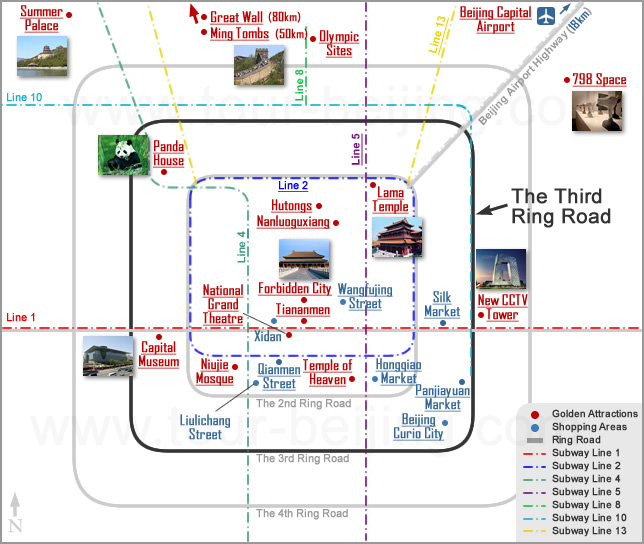
There are many places to go for shopping in Beijing, depending on what you expect and the prices you are prepared to pay; there are a rich variety of things waiting for you to explore and buy.
 |
 |
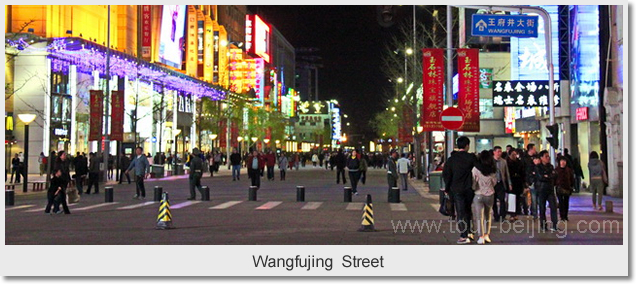
Now the street is less than one kilometer long, but it is crowded with specialty and long-history shops, which are full of modern atmosphere and high taste. It is considered as the sister street of Champs Elysees in France. Besides of its modern feature, the street also preserves the Chinese traditional style, such as the Oriental Plaza, Gongmei Building, Wangfujing Department Store, Muslim Building, Sun Dong An Plaza and so on.
 |
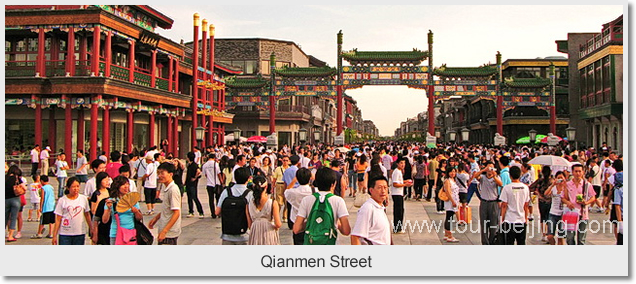
Qianmen is just in the south of the Tiananmen Square. The Qianmen Street was a commercial center of Beijing more than 500 years ago. If you are interested in the Chinese traditional products, then it will be a good place to go. Qianmen area has been remedied as per the architecture style of the Ming and Qing Dynasty.
Now the old and famous shops just like the Quanjude, Pianyi Workshop, Douyichu, all of which are the representative of the Chinese traditional culture, are congested there. Indubitably, the atmosphere of the Chinese traditional culture will be felt.
 |
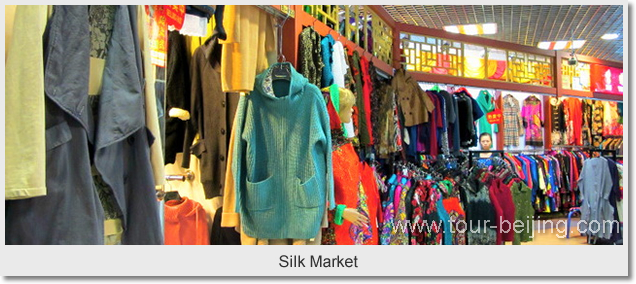
This is a seven story building which has everything included. Just as its name, the Silk Street is full of the beautiful silk products (pyjamas, robes, shirts, scarves and so on )as well as the textiles (cashmere scarves, clothes of all types, tablecloths, etc.), and handcrafts.
Besides of these, the Silk Street has much more than just silk. The new Silk Street have introduced traditional Chinese handicrafts, antiques, calligraphy, carpets, table cloths, bed coverings, paintings, hand-knit dresses, toys, electronic gadgets, trinkets, and fine jewelry. Everything here can be had cheaper than at any of the stores in the city, but remember to make the bargain for it.
 |
For many foreign tourists to Beijing, Panjiayuan Market is a must see activity. As the largest antiques market of its kind both in China and Asia, the Panjianyuan Market is made up of more than 3,000 individual stalls covering 48,500 square meters. There is really a market for everybody to come, even Hilary Clinton has shopped here.
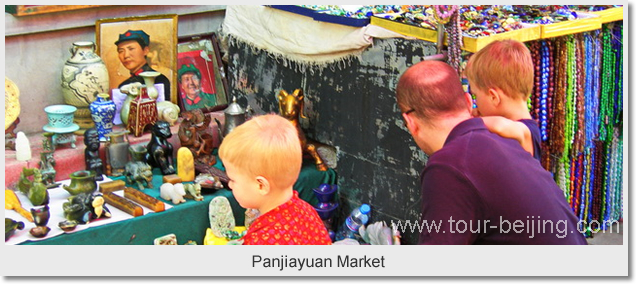 |
All kind of souvenirs are available for sale. There are reproductions from the late Qing Dynasty as well as real stuff from the Cultural Revolution era. What is known to the Chinese as the "four treasure of the study"(writing brush, ink stick, paper and ink slab), old books and paintings, ancient Chinese and foreign coins, Buddhist relics, customs of ethnic minorities, apparel are also can be found here. You'd better go there on weekends. The Antique zone is open everyday, but the Arts and Crafts Warehouse Zone is on Saturday and Sunday only.
Add: West of Panjiayuan Bridge in the Chaoyang district.
Opening hours
8:30 - 18:30 from Monday to Friday
4:30 - 18:30 Saturday and Sunday
How to get there:
Take subway line 10 get off at the final station of Jinsong (劲松), and continue to have a 15-minute walk to next bridge (Panjiayuan Bridge) in the south and West of Panjiayuan Bridge is Panjiayuan Market.
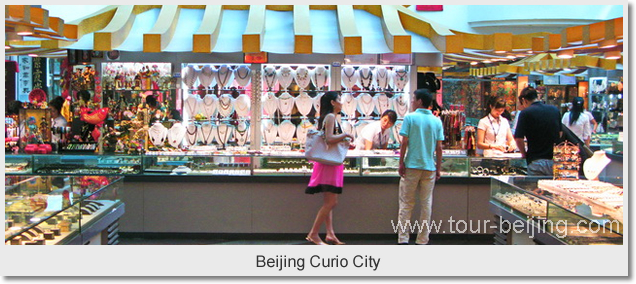 |
Add: No.21, 3rd East Ring South Road, Chaoyang District (South of Panjiayuan Market).
Tel: 010-6774 7711
Hongqiao Pear Market is a Beijing shopping favorite, not because it is relax but because it has anything you want to find, such as antiques, jewelry, clothes, food, souvenirs, gifts, toys, shoes etc. Although the quality of the goods is not always the best, but for the prices it is about what you can afford. Rather chaotic but you will have fun poking around. It is located in the south central area of Beijing, just the east entrance to the Temple of Heaven.
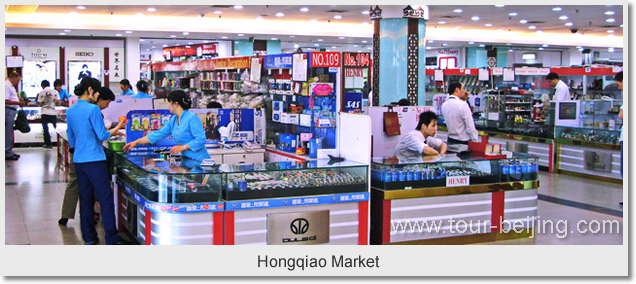 |
Add: Tiantan East Road, Donhcheng District (Almost opposite the East Gate to the Temple of Heaven)
How to get there:
Take subway line 5 and get off at the station of East Temple of Heaven (天坛东)
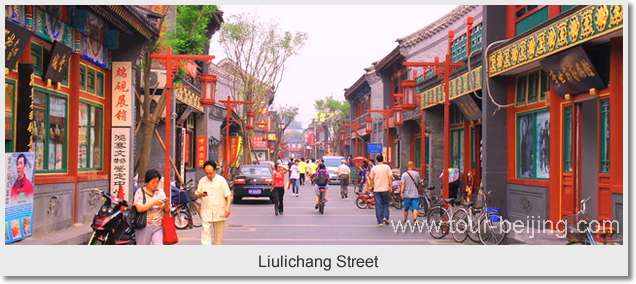 |
Liulichang is 750m long with a long history from Yuan, Ming and Qing Dynasties. The area is really a good place to these who love the Chinese culture.
How to get there:
Take subway line 2, get off at the station of Hepingmen (和平门), and exit from EXIT C2.
The market is oriented to different costumer groups, providing mid-and high-quality commodities and highlighting the distinctive feature of professionalism and completeness to meet the needs of people.
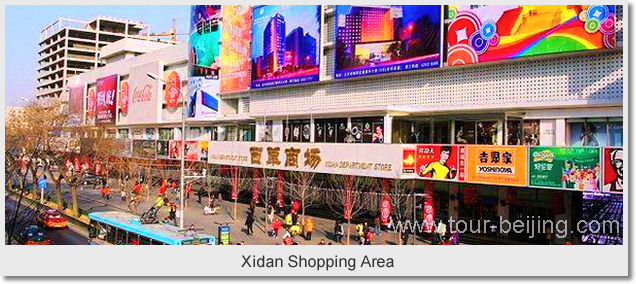 |
There are a lot of old and new shops here such as: Xidan Shopping Center, Xidan Bazaar, Chung-Yo Department Store, Huanan Mansion, Paris Photo Studio, Weiwei Bride Wedding Dress Photo Studio and Capital Bookstore.
How to get there:
Take subway line 1, get off at the station of Xidan (西单), and exit from Exit K
Real antiques are supposed to bear a red official seal that proves their authenticity, but sometimes real ones don't have it and fake ones do. The best attitude to have is: if you like it and you can bargain down to a price you can accept, just go for it. Small jade articles and silver trinkets make great presents for people at home and they are easy to take on the plane.
Now this traditional handicraft unique to Beijing features a colorful range of varieties shaped in various models including furnace, tripod, and quadripod, ash-tray, stationary and lantern. Among them, the blue glazed ones with golden colour are most colorful.
Some lacquerware is inlaid with gold, mother-of -pearl or jade, to decorate folding screens and furniture which are genuine works of art.
Most vendors at the markets are self-employed and speak some English. All the products are marked in Western sizes. Chinese long gowns are considered the most elegant garment most suitable for women's figures. Silk gowns can be a truly long-lasting and useful item to purchase in China for yourself or as gifts for those special people back home.
Clay figurines and animals can be traced back to 1840s, and are still one of the most unique crafts in North China.
Dough modeling is another traditional folk art handed down from ancient times. Kneaded in half-cooked glutinous rice flour, dough figures, flowers and birds are popular small toys and exhibits in Beijing.
Paper-cutting is one of the most popular handicrafts in Beijing. There is a wider variety of paper cutting patterns available than you can imagine.
Kites can be used as ornaments and toys. One of China's favorite past times is flying kites, especially in Beijing where there is usually plenty of wind around to send them soaring into the sky. Available in many art and craft stores, kites are among the best Chinese presents to friends back home.
Snuff bottles, with paintings inside, represent a popular art from the Qing Dynasty and make excellent small gifts. You and your friends will marvel for years on how the artist paints such intricate drawings on the inside of these very small bottles.
Bone products, made from oxen and camel bones, include knives, forks, spoons, bracelets and necklaces.
Embroidery & drawn work appear on table cloths, napkins, sheets and handkerchiefs, all of which are excellent buys, the Beijing Yuanlong Silk Corporation, Ltd. has a wide selection.
Books
Every year 20,000 book titles and 1,300 periodicals are published in Beijing, home of the Commercial Press and other well-known publishing houses. They make up a small part of the stock of the city's major book shops, where you can find beautiful art books, translations of Chinese classics and textbooks on all known subjects. Prices are reasonable, particularly in the Foreign Languages Bookstores.
The Beijing Foreign Languages Bookstore and Beijing Xinhua Bookstore (with 137 branches around town) are major book sellers. The China Book Store in Liulichang binds and repairs all kinds of books and periodicals as well as selling them.
Add On
Top 10 Beijing Markets
Top 10 Beijing Shopping Malls
Top 10 Beijing Souvenirs
 Here is only for Questions and Answers. ( For anyone who wants to have an enquiry or customized tour, please email us to
  . )
. )