

Ninxia Travel Guide
Yinchuan Travel Guide
Helanshan Rock Carving
Western Film Studio
Nanguan Mosque
Haibao Pagoda
Qingtongxia Travel Guide
Zhongwei Travel Guide
Yinchuan Travel Guide
Helanshan Rock Carving
Western Film Studio
Nanguan Mosque
Haibao Pagoda
Qingtongxia Travel Guide
Zhongwei Travel Guide
Online Booking Steps
1. Select a tour & submit
Browser a tour that most suits you and send us the tour with your custom request.
2. Quote for your tour
Receive our tour proposal with rates in one working day.
3. Adjust your tour
Modify your itinerary with new quotes for free until it fits you.
4. Confirm & deposit
Finalise your tour after receiving your deposit.
5. Final payment
Pay the balance before or upon arrival.
Browser a tour that most suits you and send us the tour with your custom request.
2. Quote for your tour
Receive our tour proposal with rates in one working day.
3. Adjust your tour
Modify your itinerary with new quotes for free until it fits you.
4. Confirm & deposit
Finalise your tour after receiving your deposit.
5. Final payment
Pay the balance before or upon arrival.
Beijing Tour
Xian Tour
Shanghai Tour
Guilin Tour
Datong Tour
Chengde Tour
Chengdu Tour
Chongqing Tour
Hong Kong Tour
Luoyang Tour
Lijiang Tour
Pingyao Tour
Inner Mongolia Tour
Harbin Tour
Hangzhou Tour
Huangshan Tour
Tianjin Tour
Qufu Tour
Mt.Taishan Tour
Jinan Tour
Qingdao Tour
Qinhuangdao Tour
Jiuzhaigou Tour
Zhangjiajie Tour
Xian Tour
Shanghai Tour
Guilin Tour
Datong Tour
Chengde Tour
Chengdu Tour
Chongqing Tour
Hong Kong Tour
Luoyang Tour
Lijiang Tour
Pingyao Tour
Inner Mongolia Tour
Harbin Tour
Hangzhou Tour
Huangshan Tour
Tianjin Tour
Qufu Tour
Mt.Taishan Tour
Jinan Tour
Qingdao Tour
Qinhuangdao Tour
Jiuzhaigou Tour
Zhangjiajie Tour
China Province Tour
Tibet Tour
Shandong Tour
Guangdong Tour
Fujian Tour
Qinghai Tour
Ninxia Tour
Guizhou Tour
Inner Mongolia Tour
Shandong Tour
Guangdong Tour
Fujian Tour
Qinghai Tour
Ninxia Tour
Guizhou Tour
Inner Mongolia Tour
Beijing Trip
Xian Trip
Shanghai Trip
Guilin Trip
Chengdu Trip
Chengde Trip
Inner Mongolia Trip
Datong Trip
Harbin Trip
Pingyao Trip
Luoyang Trip
Qufu Trip
Shangdong Trip
Hangzhou Trip
Lhasa Trip
Yangtze River Trip
Huangshan Trip
Xian Trip
Shanghai Trip
Guilin Trip
Chengdu Trip
Chengde Trip
Inner Mongolia Trip
Datong Trip
Harbin Trip
Pingyao Trip
Luoyang Trip
Qufu Trip
Shangdong Trip
Hangzhou Trip
Lhasa Trip
Yangtze River Trip
Huangshan Trip
- - - - - - - - - - - - - - - - - - - -
Beijing Travel Service
China Travel Agency
Beijing Travel Tips
Beijing Information
Beijing Travel Service
China Travel Agency
Beijing Travel Tips
Beijing Information
Home → China Travel Guide → Ningxia Travel Guide
Ningxia Travel Guide
Location:
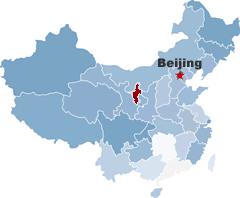
Ningxia Hui Autonomous Region, established on October 25th, 1958, is bordered by Inner Mongolia to the north and west, Shaanxi to the east and Gansu to the south.
History:
Ningxia, a region as culturally rich as the entire area south of the Yangtze River, continues to be admired for its resplendent cultural heritage garnered from the long river of history.
During the time of the Tang and Han Dynasties, Ningxia was the main place for trade and transportation between the eastern and western regions of ancient China. Ruins of the Great Wall of the Ming Dynasty can be found in east Ningxia.
Transportation:
The major means of transportation for traveling in Ningxia are flights, railway and highway.
Ningxia has an airport called Hedong Airport that is located southeast of Yinchuan. Airplanes from this airport can reach dozens of domestic cities, such as Beijing, Xian, Taiyuan, Lanzhou, Baotou, Dalian, etc.
Bao(tou)-Lan(zhou)Railway which links many key lines ,such as Jingbao, Lanxin, Lanqing, Longhai, runs through Yinchuan new urban area from north to south.
Six national highways pass through Ningxia and nearly thirty coach lines centered on Yinchuan Coach Station can reach every parts of Ningxia and even some parts of the neighboring Shanxi, Inner Mongolia and Gansu Province.
Dining:
The Mosslem people eat an Islamic food, also calling Islam at our country history because of Islamism, past.
Usually in addition to the Islamic vegetables fastens, Main the Islamic cake, moon cake, biscuit, the sesame shortcake, clip a heart bread, Islamic cow, sheep, chicken, rabbit, fish The meat can, dried sliced meat and bean product, the milk product, candy and noodles food etc..
Weather:
The region is 1,200 km from the sea and has a continental climate with average summer temperatures rising to between 17 and 24°C in July and average winter temperatures dropping to between -7 and -10°C in January.
Seasonal extreme temperatures can reach 39°C in summer and -30°C in winter. The diurnal temperature variation in summer is 17°C. Annual rainfall averages from 190 to 700 millimeters, with more rain falling in the south of the region.
Attractions:
A unique landscape, unique local customs and habits, and ancient history, all add up to make Ningxia an interesting tourist area for those wishing to discover a rich and diverse region.
One of Ningxia's main tourist spots is the famous Xixia Tombs site located 30 km west of Yinchuan. The remnants of nine Western Xia emperors' tombs and two hundred other tombs lie within a 50-km² area.
Other famous sites in Ningxia include Helan Shan, the mysterious 108 dagobas, the twin pagodas of Baisikou and the desert research outpost at Shapatou.
Here is only for Questions and Answers. ( For anyone who wants to have an enquiry or tour booking, please fill in our Online Enquiry. )
Ningxia Travel Guide
Location:
Ningxia Hui Autonomous Region, established on October 25th, 1958, is bordered by Inner Mongolia to the north and west, Shaanxi to the east and Gansu to the south.
History:
Ningxia, a region as culturally rich as the entire area south of the Yangtze River, continues to be admired for its resplendent cultural heritage garnered from the long river of history.
During the time of the Tang and Han Dynasties, Ningxia was the main place for trade and transportation between the eastern and western regions of ancient China. Ruins of the Great Wall of the Ming Dynasty can be found in east Ningxia.
Transportation:
The major means of transportation for traveling in Ningxia are flights, railway and highway.
Ningxia has an airport called Hedong Airport that is located southeast of Yinchuan. Airplanes from this airport can reach dozens of domestic cities, such as Beijing, Xian, Taiyuan, Lanzhou, Baotou, Dalian, etc.
Bao(tou)-Lan(zhou)Railway which links many key lines ,such as Jingbao, Lanxin, Lanqing, Longhai, runs through Yinchuan new urban area from north to south.
Six national highways pass through Ningxia and nearly thirty coach lines centered on Yinchuan Coach Station can reach every parts of Ningxia and even some parts of the neighboring Shanxi, Inner Mongolia and Gansu Province.
Dining:
The Mosslem people eat an Islamic food, also calling Islam at our country history because of Islamism, past.
Usually in addition to the Islamic vegetables fastens, Main the Islamic cake, moon cake, biscuit, the sesame shortcake, clip a heart bread, Islamic cow, sheep, chicken, rabbit, fish The meat can, dried sliced meat and bean product, the milk product, candy and noodles food etc..
Weather:
The region is 1,200 km from the sea and has a continental climate with average summer temperatures rising to between 17 and 24°C in July and average winter temperatures dropping to between -7 and -10°C in January.
Seasonal extreme temperatures can reach 39°C in summer and -30°C in winter. The diurnal temperature variation in summer is 17°C. Annual rainfall averages from 190 to 700 millimeters, with more rain falling in the south of the region.
Attractions:
A unique landscape, unique local customs and habits, and ancient history, all add up to make Ningxia an interesting tourist area for those wishing to discover a rich and diverse region.
One of Ningxia's main tourist spots is the famous Xixia Tombs site located 30 km west of Yinchuan. The remnants of nine Western Xia emperors' tombs and two hundred other tombs lie within a 50-km² area.
Other famous sites in Ningxia include Helan Shan, the mysterious 108 dagobas, the twin pagodas of Baisikou and the desert research outpost at Shapatou.
| Questions & Answers: |