


Ninxia Travel Guide
Yinchuan Travel Guide
Helanshan Rock Carving
Western Film Studio
Nanguan Mosque
Haibao Pagoda
Qingtongxia Travel Guide
Zhongwei Travel Guide
Yinchuan Travel Guide
Helanshan Rock Carving
Western Film Studio
Nanguan Mosque
Haibao Pagoda
Qingtongxia Travel Guide
Zhongwei Travel Guide
Online Booking Steps
1. Select a tour & submit
Browser a tour that most suits you and send us the tour with your custom request.
2. Quote for your tour
Receive our tour proposal with rates in one working day.
3. Adjust your tour
Modify your itinerary with new quotes for free until it fits you.
4. Confirm & deposit
Finalise your tour after receiving your deposit.
5. Final payment
Pay the balance before or upon arrival.
Browser a tour that most suits you and send us the tour with your custom request.
2. Quote for your tour
Receive our tour proposal with rates in one working day.
3. Adjust your tour
Modify your itinerary with new quotes for free until it fits you.
4. Confirm & deposit
Finalise your tour after receiving your deposit.
5. Final payment
Pay the balance before or upon arrival.
Beijing Tour
Xian Tour
Shanghai Tour
Guilin Tour
Datong Tour
Chengde Tour
Chengdu Tour
Chongqing Tour
Hong Kong Tour
Luoyang Tour
Lijiang Tour
Pingyao Tour
Inner Mongolia Tour
Harbin Tour
Hangzhou Tour
Huangshan Tour
Tianjin Tour
Qufu Tour
Mt.Taishan Tour
Jinan Tour
Qingdao Tour
Qinhuangdao Tour
Jiuzhaigou Tour
Zhangjiajie Tour
Xian Tour
Shanghai Tour
Guilin Tour
Datong Tour
Chengde Tour
Chengdu Tour
Chongqing Tour
Hong Kong Tour
Luoyang Tour
Lijiang Tour
Pingyao Tour
Inner Mongolia Tour
Harbin Tour
Hangzhou Tour
Huangshan Tour
Tianjin Tour
Qufu Tour
Mt.Taishan Tour
Jinan Tour
Qingdao Tour
Qinhuangdao Tour
Jiuzhaigou Tour
Zhangjiajie Tour
China Province Tour
Tibet Tour
Shandong Tour
Guangdong Tour
Fujian Tour
Qinghai Tour
Ninxia Tour
Guizhou Tour
Inner Mongolia Tour
Shandong Tour
Guangdong Tour
Fujian Tour
Qinghai Tour
Ninxia Tour
Guizhou Tour
Inner Mongolia Tour
Beijing Trip
Xian Trip
Shanghai Trip
Guilin Trip
Chengdu Trip
Chengde Trip
Inner Mongolia Trip
Datong Trip
Harbin Trip
Pingyao Trip
Luoyang Trip
Qufu Trip
Shangdong Trip
Hangzhou Trip
Lhasa Trip
Yangtze River Trip
Huangshan Trip
Xian Trip
Shanghai Trip
Guilin Trip
Chengdu Trip
Chengde Trip
Inner Mongolia Trip
Datong Trip
Harbin Trip
Pingyao Trip
Luoyang Trip
Qufu Trip
Shangdong Trip
Hangzhou Trip
Lhasa Trip
Yangtze River Trip
Huangshan Trip
- - - - - - - - - - - - - - - - - - - -
Beijing Travel Service
China Travel Agency
Beijing Travel Tips
Beijing Information
Beijing Travel Service
China Travel Agency
Beijing Travel Tips
Beijing Information
Home → China Travel Guide → Yinchuan Travel Guide
Yinchuan Travel Guide
Location:
Yinchuan, the capital of Ningxia Hui Autonomous Region, lies in the middle of the Ningxia Plain, close to Yellow River and sheltered from Helan Mountain.
History:
Yinchuan is a famous ancient fortress with more than 1300 years history.
The city of Yinchuan was first built in the early times of Tang dynasty. In the times of emperor Wudi in Han, there was a city called Diannong. The people of Han nation called it Lv City, but the people of Xiongnu and Xianbei nations called it Yinhan City. And this city was Yinchuan in the past.
In the early period of 5th century BC, the emperor of Hsia called Helianbobo built here as an advertisement and stationing place named Lizi Country. In 1227, after Yuan wiped out Xi-Hsia, the city was set up Xi-Hsia Zhongxing province, then changed the name into Ningxia province.
In 1958, Yinchuan became the capital city of Ningxia Hui nation Autonomous Region.
There are five specialties called red, yellow, blue, white and black. They are Chinese wolfberry, licorice root, Helan Stone, fresh fur coat and black moss. And the five things have a favorable reception both in China and abroad.
Transportation:
It is served by a river port at Hengcheng, about 15 km to the east. Until the 1950s, the river, which is navigable downstream as far as Baotou in the Inner Mongolian autonomous region and upstream to Zhongwei and Zhongning, was the chief communication link. Ningxia has a civil aviation airport which is in the southeast of Yinchuan City and has direct flights to scores of cities, such as Beijing, Xian, Lanzhou and Baotou.
Highways also link the city to Baotou along the river, to Lanzhou in Gansu province to the southwest, to Wuwei in Gansu to the west, and to Xi'an in Shaanxi province to the southeast.
Since 1958 the city has been on the railway from Lanzhou to Baotou and is thus linked to other parts of China by rail.
Dining:
Most of the food in Yinchuan is strongly Islamic influenced, since almost 30% of the population here is of the Muslim Hui Minority. Muslim restaurants and food stalls are found on almost every street.
The most common of these dishes are of the lamb and beef variety, accompanied by dumplings and noodles, varieties of naan style bread, flagelliform nostoc and blended teas.
The local food includes Saute Cyprinoid with Sweet and Sour Sauce, Dove Fish, Plain Steamed Lamb Meat, Sweetbread of Lamb, Mutton Eaten by Hands, etc.
You can also taste the Western food and seafood in Yinchuan.
Nightlife:
The nightlife in Yinchuan is very colorful. There are some pubs, net cafes and gymnasiums.
In Yinchuan, Hui people are good at singing and dancing. You can enjoy folk songs of strong northwest flavor called Huizu Hua'er and wonderful performances every month on the 1st and 15th days of the lunar calendar at Haibao Pagoda.
You can wander along Xinhua Jie, Jiefang Jie, and South Gate Square or have a taste of snacks at the night market in Zhongshan Beijie. In addition, dance halls, bowling alleys, swimming pools, gymnasiums as well as cafes, pubs, teashops, and various other entertainment centers can offer you an escape from the pressures of city life.
Weather:
Yinchuan has a desert climate with cold and windy (but dry) winters, dust-laden springs, hot and somewhat humid summers, and rather short autumns.
Monthly means range from −7.9 °C (17.8 °F) in January to 23.5 °C (74.3 °F) in July, with the mean for year at 9.0 °C (48.2 °F). Rainfall, is not heavy during any season, not even summer. Diurnal temperature differences tend to be large due to the aridity, which also partly contributes to the high annual sunshine hour total of just over 2,900 hours. There are 158 frost-free days.
Attractions:
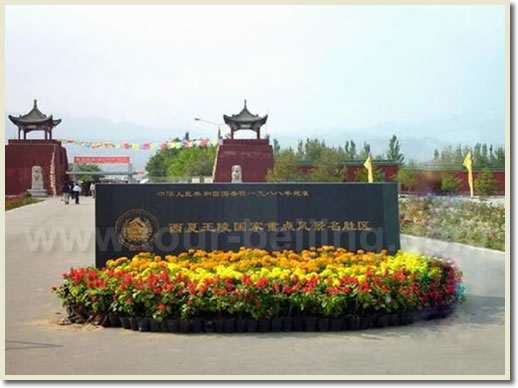
West Xia Imperial Tombs
Located on the eastern slopes of the Helan Mountains, about 35 kilometers west of the city of Yinchuan, the West Xia Imperial Tombs covers an area of about 50 square kilometers.
According to records, the tombs were patterned after Song Tombs in Gongxian County, Henan Province.
Like other imperial tombs, Western Xia mausoleums were composed of two architectural units, the mausoleum gardens above ground and underground palaces. All the mausoleum gardens faced south, and their architectural forms above ground have some unique
characteristics, though they are quite similar to mausoleums of the Tang and Northern Song dynasties in Gongxian County.
At present, only two tombs are open to the public, of which the mausoleum of Emperor Hao (the mausoleum of Weiming Yuan Hao) is the most prominent.
Sand Lake Scenic Resort
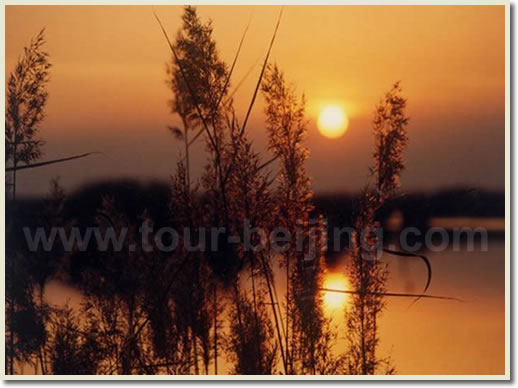
Sand Lake, located in Pingluo County of the Ningxia Autonomous Region, is one of the most exciting lakes to visit in China. The Sand Lake is about 80 square kilometers with reaching 45 square kilometers of water surface and 22.52 square kilometers of desert surface. In possession of nearly 10,000mu water areas, 5,000mu sandbanks, 2,000mu bulrush, 1,000mu lotus root ponds, Shahu Lake district is abundant in fishes and fowls. Every year during spring and autumn, over one million migratory birds stop at Sand Lake. It is a paradise for the birdwatcher as well as a great variety of birds, including white cranes, black cranes, red-crowned cranes, swans, wild ducks and mandarin ducks.
Haibao Pagoda
Located about 1.5 kilometers northwest of downtown Yinchuan in the Ningxia Hui Autonomous Region, the Haibao Pagoda Temple is one of the major Buddhist temples opened to public in China.
A 53.9-metre-high 11-floor pavilion like brick structure with a history of 1,500 years, HaibaoPagoda is the city emblem of Yinchuan. Haibao Pagoda is a pavilion-style pagoda, with nine tiers and eleven flights of stairs. A wooden stairway inside the pagoda conducts to the 9th floor for a look at the city's landscape.
The Haibao Pagoda Temple has become an important scenic spot with its entirely new appearance.
Chengtiansi Pagoda
Chengtiansi Pagoda, also known as the Western Pagoda in the Chengtian Temple, is situated in the southwest of Yinchuan, Ningxia Hui Autonomous Region.
The pagoda was first built in 1050 during the Song Dynasty. The pagoda underwent repeated repairs in the Ming and Qing dynasties. It was originally built in 1050 with a height of 64.5 meters, 13-story structure and octagon in shape, and a flight of wooden stairs reach to the 11 floors.
Chengtiansi Pagoda has been well preserved and become one of key protected cultural relic sites. The admission fee is RMB 22.
Here is only for Questions and Answers. ( For anyone who wants to have an enquiry or tour booking, please fill in our Online Enquiry. )
Yinchuan Travel Guide
Location:
Yinchuan, the capital of Ningxia Hui Autonomous Region, lies in the middle of the Ningxia Plain, close to Yellow River and sheltered from Helan Mountain.
History:
Yinchuan is a famous ancient fortress with more than 1300 years history.
The city of Yinchuan was first built in the early times of Tang dynasty. In the times of emperor Wudi in Han, there was a city called Diannong. The people of Han nation called it Lv City, but the people of Xiongnu and Xianbei nations called it Yinhan City. And this city was Yinchuan in the past.
In the early period of 5th century BC, the emperor of Hsia called Helianbobo built here as an advertisement and stationing place named Lizi Country. In 1227, after Yuan wiped out Xi-Hsia, the city was set up Xi-Hsia Zhongxing province, then changed the name into Ningxia province.
In 1958, Yinchuan became the capital city of Ningxia Hui nation Autonomous Region.
There are five specialties called red, yellow, blue, white and black. They are Chinese wolfberry, licorice root, Helan Stone, fresh fur coat and black moss. And the five things have a favorable reception both in China and abroad.
Transportation:
It is served by a river port at Hengcheng, about 15 km to the east. Until the 1950s, the river, which is navigable downstream as far as Baotou in the Inner Mongolian autonomous region and upstream to Zhongwei and Zhongning, was the chief communication link. Ningxia has a civil aviation airport which is in the southeast of Yinchuan City and has direct flights to scores of cities, such as Beijing, Xian, Lanzhou and Baotou.
Highways also link the city to Baotou along the river, to Lanzhou in Gansu province to the southwest, to Wuwei in Gansu to the west, and to Xi'an in Shaanxi province to the southeast.
Since 1958 the city has been on the railway from Lanzhou to Baotou and is thus linked to other parts of China by rail.
Dining:
Most of the food in Yinchuan is strongly Islamic influenced, since almost 30% of the population here is of the Muslim Hui Minority. Muslim restaurants and food stalls are found on almost every street.
The most common of these dishes are of the lamb and beef variety, accompanied by dumplings and noodles, varieties of naan style bread, flagelliform nostoc and blended teas.
The local food includes Saute Cyprinoid with Sweet and Sour Sauce, Dove Fish, Plain Steamed Lamb Meat, Sweetbread of Lamb, Mutton Eaten by Hands, etc.
You can also taste the Western food and seafood in Yinchuan.
Nightlife:
The nightlife in Yinchuan is very colorful. There are some pubs, net cafes and gymnasiums.
In Yinchuan, Hui people are good at singing and dancing. You can enjoy folk songs of strong northwest flavor called Huizu Hua'er and wonderful performances every month on the 1st and 15th days of the lunar calendar at Haibao Pagoda.
You can wander along Xinhua Jie, Jiefang Jie, and South Gate Square or have a taste of snacks at the night market in Zhongshan Beijie. In addition, dance halls, bowling alleys, swimming pools, gymnasiums as well as cafes, pubs, teashops, and various other entertainment centers can offer you an escape from the pressures of city life.
Weather:
Yinchuan has a desert climate with cold and windy (but dry) winters, dust-laden springs, hot and somewhat humid summers, and rather short autumns.
Monthly means range from −7.9 °C (17.8 °F) in January to 23.5 °C (74.3 °F) in July, with the mean for year at 9.0 °C (48.2 °F). Rainfall, is not heavy during any season, not even summer. Diurnal temperature differences tend to be large due to the aridity, which also partly contributes to the high annual sunshine hour total of just over 2,900 hours. There are 158 frost-free days.
Attractions:
West Xia Imperial Tombs
Located on the eastern slopes of the Helan Mountains, about 35 kilometers west of the city of Yinchuan, the West Xia Imperial Tombs covers an area of about 50 square kilometers.
According to records, the tombs were patterned after Song Tombs in Gongxian County, Henan Province.
Like other imperial tombs, Western Xia mausoleums were composed of two architectural units, the mausoleum gardens above ground and underground palaces. All the mausoleum gardens faced south, and their architectural forms above ground have some unique
characteristics, though they are quite similar to mausoleums of the Tang and Northern Song dynasties in Gongxian County.
At present, only two tombs are open to the public, of which the mausoleum of Emperor Hao (the mausoleum of Weiming Yuan Hao) is the most prominent.

Sand Lake Scenic Resort
Sand Lake, located in Pingluo County of the Ningxia Autonomous Region, is one of the most exciting lakes to visit in China. The Sand Lake is about 80 square kilometers with reaching 45 square kilometers of water surface and 22.52 square kilometers of desert surface. In possession of nearly 10,000mu water areas, 5,000mu sandbanks, 2,000mu bulrush, 1,000mu lotus root ponds, Shahu Lake district is abundant in fishes and fowls. Every year during spring and autumn, over one million migratory birds stop at Sand Lake. It is a paradise for the birdwatcher as well as a great variety of birds, including white cranes, black cranes, red-crowned cranes, swans, wild ducks and mandarin ducks.

Haibao Pagoda
Located about 1.5 kilometers northwest of downtown Yinchuan in the Ningxia Hui Autonomous Region, the Haibao Pagoda Temple is one of the major Buddhist temples opened to public in China.
A 53.9-metre-high 11-floor pavilion like brick structure with a history of 1,500 years, HaibaoPagoda is the city emblem of Yinchuan. Haibao Pagoda is a pavilion-style pagoda, with nine tiers and eleven flights of stairs. A wooden stairway inside the pagoda conducts to the 9th floor for a look at the city's landscape.
The Haibao Pagoda Temple has become an important scenic spot with its entirely new appearance.
Chengtiansi Pagoda
Chengtiansi Pagoda, also known as the Western Pagoda in the Chengtian Temple, is situated in the southwest of Yinchuan, Ningxia Hui Autonomous Region.
The pagoda was first built in 1050 during the Song Dynasty. The pagoda underwent repeated repairs in the Ming and Qing dynasties. It was originally built in 1050 with a height of 64.5 meters, 13-story structure and octagon in shape, and a flight of wooden stairs reach to the 11 floors.
Chengtiansi Pagoda has been well preserved and become one of key protected cultural relic sites. The admission fee is RMB 22.
| Questions & Answers: |