



Jiaoshan Great Wall Hike
The D21 Train arrived at Qinhuangdao Station as scheduled at 9:20am, June 02, 2009. The train stopped at Qinhuangdao only for one minute! We had to get ready to disembark in advance. Like some of the train stations in China, The square in front Qinhuangdao Train Station looks a bit messy. We went to the taxi waiting stand and found all the taxi were waiting randomly there with nobody keeping order. We deliberaterly chose a taxi driver with a honest face. Our first stop was Jiaoshan Great Wall, about 23km north of Qinhuangdao, 3km north of Shanhaiguan. This section of the Great Wall of China was built during the reign of Emperor Hongwu (1328-1398) in Ming Dynasty, just 7-8 km north of Laolongtou - Old Dragon's Head - the eastern tip of the Great Wall or the east end. The wall is called Jiaoshan Great Wall due to its location on the Jiaoshan Hill, the first hill the wall ascends from east to west.
We drove along the National Road No.102 to the Jiaoshan Great Wall. In the course of the short drive, our local farmer-turned driver told us some interesting antidates about the wall. He said, from 1984, the local government started to rebuild part of the Jiaoshan Great Wall under the call of "Return Our Great Wall and Build Our Great Wall" set forth by the central government in Beijing, which, I guessed, aimed at listing the Great Wall of China on the world cultural heritage. You know, in 1987, the Great Wall of China was successfully listed as the world cultural heritage. He said, during the reconstruction time, a farm could earn 0.8 yuan ( 6.8 yuan = 1 US$ ) by carrying a huge wall stone or a brick to the top of the hill for amending the great wall.
He went on to say that they often played hide-and-seek on the wall, or other childhood games when he was a boy. He even said it was quite common that the local farmers used the wall stones or bricks to build their own houses or pave the roads. The Ming Dynasty Wall was mainly composed of brick, stone or the two materials in mixture while the wall built before the Ming Dynasty was heavily built of earth, earth, stones, and wood. The wall during Ming construction was stronger and more elaborate due to the use of bricks and stone instead of rammed earth.
Upon arrival at the entrance to the wall, we found the place was very quite, less tourists than expected. This confirmed what the driver had just said that they had a hard time this year due to the swine flu, and the number of Russian holiday makers greatly decreased as well other tourist markets including doestic market. The first thing we saw was a huge gate in the style of Ming Dynasty resembling the Chinese character"ɽ"( meaning "Hill "). We looked from the ground, the wall seemed high and precipitous. Though we knew that the wall is only about 1500 meters long and noses down to the ground for easy hike up, to save energy, we still decided to take a chairlift to the top, and then hiked down the wall.
Xiao Hao was a little scared of the chairlift and kept still till landed on the top. It was a fine day. Sitting on the moving chairlift gave you an oppotrunity to have a bird-eye' view of the wall and the surrounding hills. It was a pity that we were here not in the birding time. We could not find many birds, especially the mountain birds on the Jiaoshan Hill. Usually spring and autumn are the best time for bird watching.
The chairlift station on the top is about 100 meters west of the wall. So when we got off the chairlift, we had to walk down about 100 meters to the highest point of the Jiaoshan Great Wall. Along the 1500-meter wall, there are 5 watch towers and batter forts, and 1 pass at short intervals. We first came to the top tower. On the tower, we were disppointed to find that the wild and genuine section of the wall is blocked for hike due to its treacherousness. This wild section looks like a gray dragon snaking up the hill. The top tower is the highest point we could go up on the wall. Turned back facing the south, we had a panoramic view of the Shanhaiguan City and the sea in the mist.
Looking down, we saw the great wall was quite steep and narrow in some sections.
The most interesting thing while hiking down was that the wall or the hill was too steep that we had to use the sky iron ladders to hike up and down the towers which were built at short intervals. The use of sky iron ladders is seldom found in other sections of the Great Wall in Beijing or other places. We thought all the ladders were added during the reconstruction, not originally made. But this didn't disappoint us. Instead, we felt quited excited about the ladder climbing. The further down we hiked, the more artificial the wall looked. I think the reconstrction starts from the ground in order for tourists to easily climb up. So the beginning part looks quite man-made. But this doesn't prevent us to conclude that the Jiaoshan Great Wall is worth hiking if you want to learn more about the Great Wall of China.
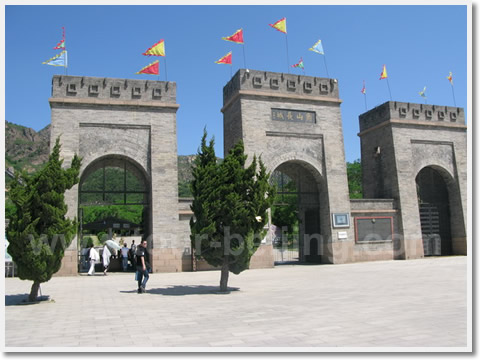
A big entrance gate in the style of Ming Dynasty resembling the Chinese character"ɽ"( meaning "Hill")
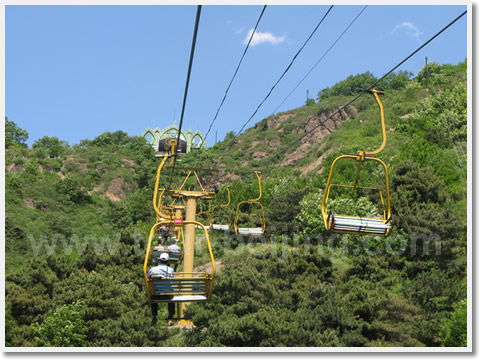
Sitting on the moving chairlift gave you an opportunity to have a bird-eye' view of the wall and the surrounding hills.
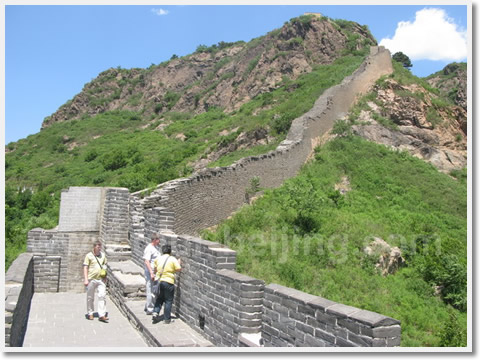
The wild and genuine section of the wall is blocked for hike due to its treacherousness.
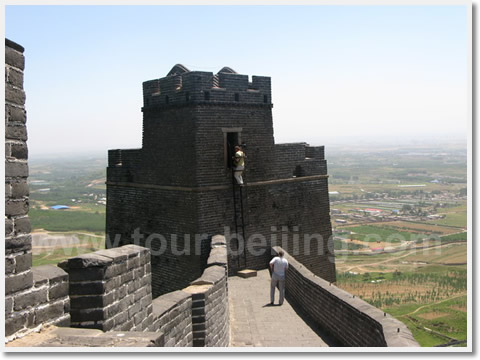
Climb up the watch tower by the use of an iron ladder.
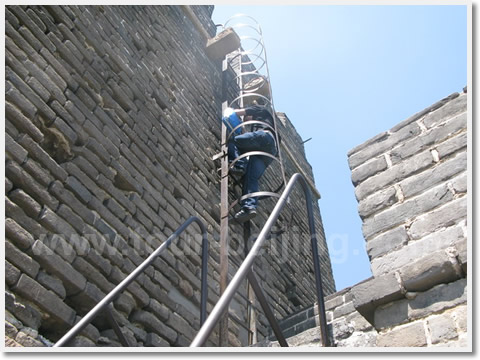
Hike down the watch tower with the help of an iron ladder.
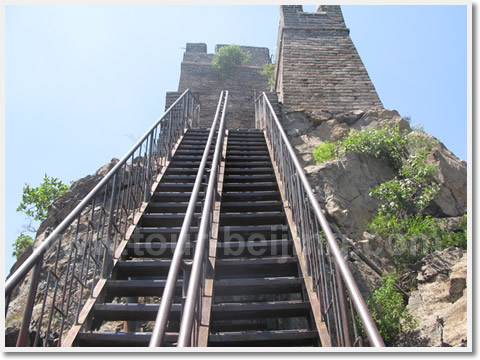
The short-interval watch towers are connected by the iron ladder.
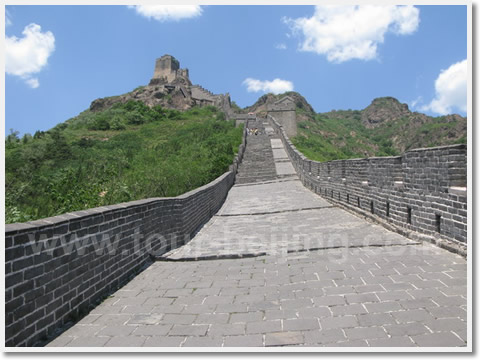
Looking up at the Great Wall from the lower section.
| Previous | 1 | 2 | 3 | 4 | 5 | 6 | 7 | Next |
Questions & Answers:
 Here is only for Questions and Answers. ( For anyone who wants to have an enquiry or customized tour, please email us to
  . )
. )