


Beijing Tour packages
Beijing Day Tours
Great Wall Tour
Beijing Coach Tours
Beijing Hutong Tours
Beijing Half Day Tours
Beijing Night Tours
Beijing Bike Tours
Beijing Walking Tour
Beijing Kids Tour
Beijing Side Trips
Beijing Day Tours
Great Wall Tour
Beijing Coach Tours
Beijing Hutong Tours
Beijing Half Day Tours
Beijing Night Tours
Beijing Bike Tours
Beijing Walking Tour
Beijing Kids Tour
Beijing Side Trips
Beijing Airport Transfer
Beijing Railway Transfer
Beijing Car Rental
Xingang Port Transfer
Beijing Layover
Beijing Airport Bus
Beijing Railway Transfer
Beijing Car Rental
Xingang Port Transfer
Beijing Layover
Beijing Airport Bus
Great Wall Tour
Beijing Spa Tours
Beijing Village Tours
Beijing Cooking Tours
Target Shooting Tour
Bird Watching Tour
Modern City Tour
Martial Arts Tour
Old Hutong Tours
Beijing Bike Tour
Beijing Museum Tour
Beijing Evening Tours
Beijing Flower Tour
Beijing Fall Foliage Tour
Beijing Ski
Beijing Winter Tour
Beijing Spa Tours
Beijing Village Tours
Beijing Cooking Tours
Target Shooting Tour
Bird Watching Tour
Modern City Tour
Martial Arts Tour
Old Hutong Tours
Beijing Bike Tour
Beijing Museum Tour
Beijing Evening Tours
Beijing Flower Tour
Beijing Fall Foliage Tour
Beijing Ski
Beijing Winter Tour
Beijing Facts
Beijing Travel Tips
Beijing Tour Maps
Beijing Sightseeing
Beijing Attractions
Beijing Transportation
Beijing Dining & Restaurants
Beijing Museum Guide
Beijing Nightlife
Beijing Climate
Beijing Shopping
Beijing Entertainment
Airlines Information
Beijing Foreign Embassies
Beijing Exhibitions
Beijing Travel
Beijing Travel Tips
Beijing Tour Maps
Beijing Sightseeing
Beijing Attractions
Beijing Transportation
Beijing Dining & Restaurants
Beijing Museum Guide
Beijing Nightlife
Beijing Climate
Beijing Shopping
Beijing Entertainment
Airlines Information
Beijing Foreign Embassies
Beijing Exhibitions
Beijing Travel
Forbidden City
Tiananmen Square
The Great Wall
Summer Palace
Temple of Heaven
Ming Tombs
Hutong Tour
Lama Temple
Capital Museum
Olympic Stadiums
Tiananmen Square
The Great Wall
Summer Palace
Temple of Heaven
Ming Tombs
Hutong Tour
Lama Temple
Capital Museum
Olympic Stadiums
Badaling Great Wall
Juyongguan Great Wall
Huanghuacheng Great Wall
Mutianyu Great Wall
Jinshanling Great Wall
Simatai Great Wall
Juyongguan Great Wall
Huanghuacheng Great Wall
Mutianyu Great Wall
Jinshanling Great Wall
Simatai Great Wall
Hongqiao Pearl Market
Baoguosi Culture Market
Beijing Tianya Hongqiao
Beijing Antique City
Panjiayuan Flea Market
Shopping at The Place
Shopping at Nanluoguxiang
Shopping at Yandaixiejie
Baoguosi Culture Market
Beijing Tianya Hongqiao
Beijing Antique City
Panjiayuan Flea Market
Shopping at The Place
Shopping at Nanluoguxiang
Shopping at Yandaixiejie
Beijing MICE & DMC
Beijing Incentive Travel
Beijing Event Planning
Beijing Business Travel
Cultural Immersion in Beijing
Beijing Incentive Travel
Beijing Event Planning
Beijing Business Travel
Cultural Immersion in Beijing
Beijing Student Travel
Student travel information on Beijing tour, hostels, nightlife, travel tips...
Beijing Senior Travel
Travel service for older adults through educational tours and senior travel tips.
Beijing Disability Travel
Beijing Disability travel and tour information for wheelchair users, wheelchair travelers and slow walkers.
Beijing Women Travel
Beijing tour information on women travel, shopping, cuisine, fashion, travel tips, kids, women life, safety...
Beijing Independent Travel
Independent Beijing Travel with Unbiased Beijing independent tour travel infomation.
Student travel information on Beijing tour, hostels, nightlife, travel tips...
Beijing Senior Travel
Travel service for older adults through educational tours and senior travel tips.
Beijing Disability Travel
Beijing Disability travel and tour information for wheelchair users, wheelchair travelers and slow walkers.
Beijing Women Travel
Beijing tour information on women travel, shopping, cuisine, fashion, travel tips, kids, women life, safety...
Beijing Independent Travel
Independent Beijing Travel with Unbiased Beijing independent tour travel infomation.
Home → Beijing Tours → Beijing Attractions → Top 10 in Beijing → Peking (Beijing) Opera
Peking (Beijing) Opera

Beijing ( Peking ) opera is a national treasure with a history of over 200 years. It can date back to the 55th year of the reign of Emperor Qianlong of the Qing Dynasty(1790) when the four big Huiban opera Troupes entered the capital and mixed with Kunqu opera, Yiyang opera, Hanju opera and Luantan in Beijing's thearetical field at the time. With over half a century of mixture and combination of various kinds of opera there came the present Peking ( Beijing ) opera, the most impressive kind of opera in China. It is rich in repertoire with large number of artists of performance and of audiences. It has a profound influence in China. For western ears, the Peking Opera might need getting used to. The story is sometimes difficult to follow. It is very colourful bright and extremely noisy and bears absolutely no resemblance to western opera.
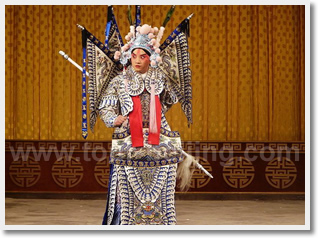
Peking opera - a number of combined stylized actions:
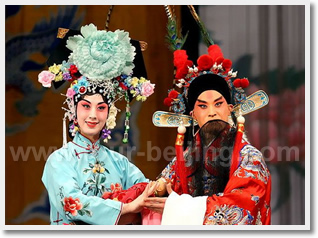
Beijing Opera is a number of stylized action, including singing, dancing, dialogue and acrobatic fighting to tell a story or present different characters and their feelings of happiness, anger, sorrow, surprise, fear and sadness. In Peking opera there are four main types of roles: sheng (male) dan (young female), jing( painted face,male), and chou (clown, male or female). The characters may be loyal or treacherous, beautiful or ugly, good or bad, their images being vividly presented.
The rich repertoire of Peking Opera:
Beijing Opera is mainly about the tales of successive dynasties regarding important historical events, emperors, ministers and generals, geniuses and great beauties, from
the ancient times to Yao, Shun, Yu, the Spring and Autumn Period, the Warring States Period and the dynasties of Qin, Han, Sui, Tang, Song, Yuan, Ming, Qing for 5000 years.
The music of Peking Opera:
The music is that of the "plate and cavity style". With harmonious rhythms, its melody is graceful and pleasing to the ears. The melody may be divided into two parts: "Xipi" and "erhong". The chief patterns are guiding pattern, original pattern, slow pattern, quick pattern. The performance is coupled by a tune played on wind instruments, stringed instruments and percussion instruments. The chief musical instruments is jinghu which is a two-stringed bowed instrument with a high register, yueqin which is a four-stringed plucked instrument with a full-moon-shaped sound box, Sanxian which is a three-stringed plucked instrument, suona horn, flute drum, large-gong, cymbals, tiny-gong, etc.
The costumes in Peking opera:
The costumes are graceful, magnificent, elegant and bright. As the conventional Chinese pattern are used, the costumes are of a high value. Peking Opera costumes show the beauty of traditional Chinese embroidery: surface embroidery with gold or silver threads; woollen embroidery with silk or gold threads, among many others. Every costume is a masterpiece of art and craft. One costume with elaborate designs and patterns may take a handicraftsman months or even years to finish, and the best are indeed priceless.
The types of facial make-ups in Peking opera:
The types of facial make-ups are rich and various, showing various characters and remarkable images, therefore they are highly appreciated. Moreover there are numerous fixed editions of facial make-up. For the painted role, the different colors of the faces depict different characters and personality. Yellow and white shows cunning, red represents uprightness and loyalty, black depicts valor and wisdom, blue and green stands for the vigorous character of rebellious heroes and gold and silver represent mystic or super-natural things.
The most famous actor - Mei Lanfang:
He is the most popular Beijing Opera singer and he even had some performances in Japan,Europe, and USA. With his voice, movements, style, he played female roles perfectly. It is a good idea to visit the Residence of Mr. Mei Lanfang (1894 - 1961). Open: daily 9:00 -12: 00 a.m. and 1:00 - 4:00 p.m. (except Monday).
Beijing Opera Major Houses:
Huguang Huiguan Ancient Opera Building
Add: 3 Hufang Road, Xuanwu District ,Beijing
Tel: 63529134
Time: 9: 00---19: 00 closed on Monday
Bus: Take buses NO.5,6,23,50,53,102,105 and get off at Hufangqiao stop
Ticket: 150 yuan
Liyuan Theatre
Add: 1/F Qianmen Hotel, Yongan Road, Hufangqiao, Xuanwu District, Beijing
Tel: 63540841
Bus: Take bus NO.19,40,59,61,122,819 and get off at Hufangqiao stop
Ticket: 20---150yuan
Chang'an Grand Theatre
Add:In the Guanghua Chang an piazza ,East Chang an Avenue
Tel:65101309
Time:afternoon and evening show
Ticket: 20---180yuan
Zhengyici Theatre
Add: 220 Xiheyan Street
Tel: 63036233
Time: from 19:15pm
Ticket: 20---180yuan
For a fast answer, fill the email-form below and we'll get back to you by e-mail within 24 hours.
Peking (Beijing) Opera

Beijing ( Peking ) opera is a national treasure with a history of over 200 years. It can date back to the 55th year of the reign of Emperor Qianlong of the Qing Dynasty(1790) when the four big Huiban opera Troupes entered the capital and mixed with Kunqu opera, Yiyang opera, Hanju opera and Luantan in Beijing's thearetical field at the time. With over half a century of mixture and combination of various kinds of opera there came the present Peking ( Beijing ) opera, the most impressive kind of opera in China. It is rich in repertoire with large number of artists of performance and of audiences. It has a profound influence in China. For western ears, the Peking Opera might need getting used to. The story is sometimes difficult to follow. It is very colourful bright and extremely noisy and bears absolutely no resemblance to western opera.
Peking opera - a number of combined stylized actions:
Beijing Opera is a number of stylized action, including singing, dancing, dialogue and acrobatic fighting to tell a story or present different characters and their feelings of happiness, anger, sorrow, surprise, fear and sadness. In Peking opera there are four main types of roles: sheng (male) dan (young female), jing( painted face,male), and chou (clown, male or female). The characters may be loyal or treacherous, beautiful or ugly, good or bad, their images being vividly presented.
The rich repertoire of Peking Opera:
Beijing Opera is mainly about the tales of successive dynasties regarding important historical events, emperors, ministers and generals, geniuses and great beauties, from
the ancient times to Yao, Shun, Yu, the Spring and Autumn Period, the Warring States Period and the dynasties of Qin, Han, Sui, Tang, Song, Yuan, Ming, Qing for 5000 years.The music of Peking Opera:
The music is that of the "plate and cavity style". With harmonious rhythms, its melody is graceful and pleasing to the ears. The melody may be divided into two parts: "Xipi" and "erhong". The chief patterns are guiding pattern, original pattern, slow pattern, quick pattern. The performance is coupled by a tune played on wind instruments, stringed instruments and percussion instruments. The chief musical instruments is jinghu which is a two-stringed bowed instrument with a high register, yueqin which is a four-stringed plucked instrument with a full-moon-shaped sound box, Sanxian which is a three-stringed plucked instrument, suona horn, flute drum, large-gong, cymbals, tiny-gong, etc.
The costumes in Peking opera:
The costumes are graceful, magnificent, elegant and bright. As the conventional Chinese pattern are used, the costumes are of a high value. Peking Opera costumes show the beauty of traditional Chinese embroidery: surface embroidery with gold or silver threads; woollen embroidery with silk or gold threads, among many others. Every costume is a masterpiece of art and craft. One costume with elaborate designs and patterns may take a handicraftsman months or even years to finish, and the best are indeed priceless.
The types of facial make-ups in Peking opera:
The types of facial make-ups are rich and various, showing various characters and remarkable images, therefore they are highly appreciated. Moreover there are numerous fixed editions of facial make-up. For the painted role, the different colors of the faces depict different characters and personality. Yellow and white shows cunning, red represents uprightness and loyalty, black depicts valor and wisdom, blue and green stands for the vigorous character of rebellious heroes and gold and silver represent mystic or super-natural things.
The most famous actor - Mei Lanfang:
He is the most popular Beijing Opera singer and he even had some performances in Japan,Europe, and USA. With his voice, movements, style, he played female roles perfectly. It is a good idea to visit the Residence of Mr. Mei Lanfang (1894 - 1961). Open: daily 9:00 -12: 00 a.m. and 1:00 - 4:00 p.m. (except Monday).Beijing Opera Major Houses:
Huguang Huiguan Ancient Opera Building
Add: 3 Hufang Road, Xuanwu District ,Beijing
Tel: 63529134
Time: 9: 00---19: 00 closed on Monday
Bus: Take buses NO.5,6,23,50,53,102,105 and get off at Hufangqiao stop
Ticket: 150 yuan
Liyuan Theatre
Add: 1/F Qianmen Hotel, Yongan Road, Hufangqiao, Xuanwu District, Beijing
Tel: 63540841
Bus: Take bus NO.19,40,59,61,122,819 and get off at Hufangqiao stop
Ticket: 20---150yuan
Chang'an Grand Theatre
Add:In the Guanghua Chang an piazza ,East Chang an Avenue
Tel:65101309
Time:afternoon and evening show
Ticket: 20---180yuan
Zhengyici Theatre
Add: 220 Xiheyan Street
Tel: 63036233
Time: from 19:15pm
Ticket: 20---180yuan
| Want a quick enquiry ? |