



Prince Gong's Mansion
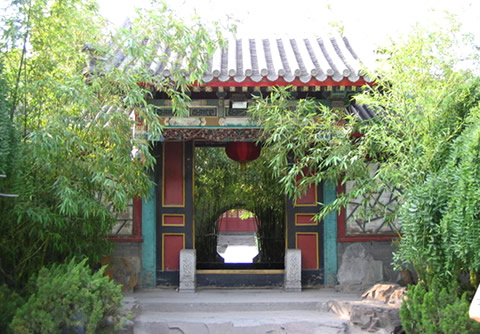
Prince Gong's Mansion is situated close to Shichahai Lake, to the northwest of the Forbidden City in Beijing. As the private living place of He Shen, a favorite minister of Emperor Qianlong of the Qing Dynasty (1644-1911), it was first constructed in 1777. In 1851, the mansion was offered to Prince Gong by Emperor Xianfeng (1851-1862), hence the name. Now it is the most well preserved mansion in Beijing.
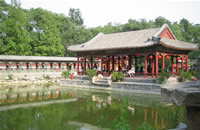 The Mansion is composed of three complexes of buildings,central, eastern and western. In this mansion, however, the Central Spirit Hall was destroyed. The rear hall is a two-storey structure more than 180 metres wide. An unusal wooden artificial hill forms the flight of stairs which gives access to the building. The buildings to the east are constructed in typical Ming style. A Chinese wisteria plant with a history of more than 200 years is still growing in front of it.
The main courtyard of the western complex includes the Xijin Studio as its main hall and is entered via a gate with the name of "Courtyard of Heavenly Fragrance" carved above it. Surrounding the courtyard is a series of elegant rooms separated by "nanmu" (a kind of cedar tree) partitions. In the centre of the courtyard are two rare midget crabapple trees nearly 300 years old.
The garden to the north of the rear hall was designed on a large scale without the constraints imposed on the mansion's formal buildings. The front section of the garden contains a hill made of piled stones, an ancient wall, the Liubei Pavilion, the Peak That Has Flown In and the Green Cloud Mountain Range.
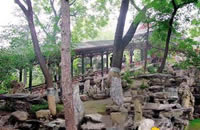 The rear section of the garden has a multi-leveled artificial hill built of Lake Tai stones. The bottom level has tunnels running through it and contains a stone with the character "fu" (meaning happiness in Chinese) written on it in the calligraphy of Qing Emperor Kangxi (1662-1722). On the second level are two pools where fine lotuses bloom in late summer and early autumn. A small pavilion with a terrace stands on the hilltop and is considered an ideal place for viewing the moon. A fishing pond stands in front of the hill. The eastern courtyard of the garden is surrounded by a low wall and contains a luxuriance of flowers and trees. Screened by the man-made hill is the Hall of Happiness built in Such a way that sunlight falls on it from dawn to dusk. The building is said to be the only one of its kind in Beijing at the present time.
According to recent research by literary scholars, it was at this Mansion that Cao Xueqin, author of "A Dream of Red Mansions", lived the life he was to write about in his famous novel.
The princes' mansions and large-scale private houses in Beijing were often built with walled flower gardens laid out either behind or to the sides of the main buildings. Nowadays, a few such mansions dating from the Ming Dynasty are still standing. These gardens are ingeniously constructed with complementary buildings and terraces, well spaced vegetation and hill paths that wind their way around cool and tranquil grottos.
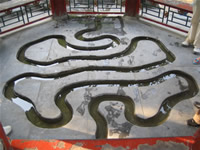 They are an exquisite combination ofclassical Chinese architecture and tasteful landscape.
Besides its artificial hill, trees, flowers, pavilions and terraces, the garden also has the unique feature of its own theater.This theater is high and spacious, with warm lighting, and on its walls there are Chinese wisteria and green leaves painted, offering the audience the feeling they are sitting under trellises. The seats are old-fashioned wooden armchairs furnished with square tables. The performers and the audience are in close contact, so there is no request for audio amplifying equipment. Here, people can enjoy kunqu, Beijing Opera and royal music, a unique experience full of Qing historical life.
To let visitors have a better understanding of the culture relating to the mansion, the management of Prince Gong's Mansion has turned Bat Hall into a teahouse. The visitors' program covers a full trip of the mansion, tea drinking, enjoying the exquisite art of the tea ceremony, tasting Beijing style food and enjoying folklore performances, all of which make a quick response. There is also a show of the history of the Qing Dynasty, including replicas and pictures of cultural relics. The exhibits date back to 1616, when the Qing Dynasty was established.
Beginning from as early as 1421 AD, a lot of princes' mansions were built in this city. As time went by, few such mansions have been left so far.
Add: A14, Liuyin Street, Xicheng District, Beijing.
Take Trolley Bus 111, 107, or 108 and Bus 13, 701 or 823, and get off at Beihai Houmen stop.
Open Hour: 8:30 -- 17:00
Entrance: 40 yuan
Tel: 8610-66116053
Questions & Answers:
 Here is only for Questions and Answers. ( For anyone who wants to have an enquiry or customized tour, please email us to
  . )
. )