

Top 10 Must See Places in China
One day, Karen, a client from the internet wrote to me directly and asked me about my top 10 must see places in China.
Hi Daniel, |
||
I replied to her quickly with my version of the top 10 places in China. She said she found it a very good guide for first time visitors to China. She advised me to post my suggestions here. It may be helpful for other visitors. It may inspire many readers to make their own top 10 list about China, or their own countries.
| China Top 10 List | China Top 10 Tour Map | Introduction to China Top 10 |
| How to Visit China Top 10 | How to Plan Your China Trip | About the Author |
| Questions & Answers |
China Top 10
![]() |
![]() |
![]() |
![]() |
![]() |
| Beijing | Xian | Shanghai | Guilin | Yangtze River |
![]() |
![]() |
![]() |
![]() |
![]() |
| Lhasa Tibet | Jiuzhaigou Sichuan | Lijiang Yunnan | Zhangjiajie Hunan | Silk Road in China |
China Top 10 Tour Map
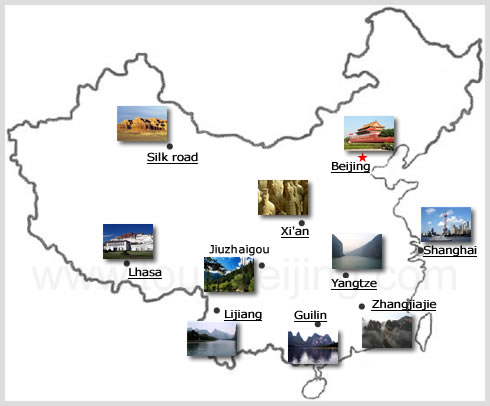
Brief Introduction to China Top 10
1. Beijing
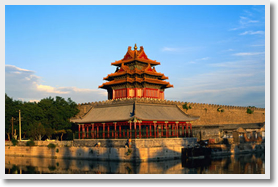
Beijing is the capital of the People's Republic of China, the center of the nation's politics, culture and international exchanges and a moden metropolis full of vitality. Beijing is one of the six ancient cities in China together with Xian, Luoyang, Kaifeng, Nanjing and Hangzhou. It had served as the capital for the dynasties such as Jin (1115 AD - 1234 AD), Yuan (1279 AD -1368 AD), Ming (1368 AD -1644 A D) and Qin (1644 AD - 1911 AD).Top attractions in Beijing:
Tiananmen Square, Forbidden City, Temple of Heaven, Summer Palace, the Great Wall, Ming Tomb, Hutong, Lama Temple, Beihai Park, Beijing Capital Museum, Yashow Market and more... top
- - - - - - - - - - - - - - - - - - - - - - - - - - - - - - - - - - - - - - - - - - - - - - - - - - - - - - - - - - - - - - - - - - - - - - - - - - - - - - - - - - - - - - -
2. Xian
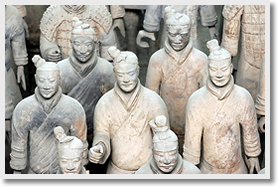
Xi'an, also called Changan is the largest city in north-west China. It had served as the nation's capital for 13 dynasties such as Western Zhou (11th century BC - 771 BC), Qin (221 BC - 206 BC), Western Han (206 BC - 24 AD) and Tang (618 - 907) for more than 1000 years. It is famous for historical importance.Top attractions in Xian:
Terra-cotta Army, Banpo Museum, Huaqing Hotspring, City Wall, Big Goose Pagoda, Shaanxi Provincial Museum, Xian Great Mosque, Forest of Stone Steles Museum and more... top
- - - - - - - - - - - - - - - - - - - - - - - - - - - - - - - - - - - - - - - - - - - - - - - - - - - - - - - - - - - - - - - - - - - - - - - - - - - - - - - - - - - - - - -
3. Shanghai
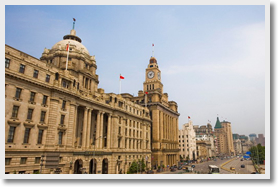
As the largest city in China, Shanghai is located in central-eastern China, confronting the East China Sea. Shanghai is mainly sectioned into two parts: Pudong (east of the Huangpu River) and Puxi (west of the Huangpu River). Pudong is the new development zone. Shanghai has two airports - Shanghai Pudong International Airport ( PVG ) and Shanghai Hongqiao Airport. Shanghai Pudong International Airport caters for international flights while Hongqiao for domestic flights.Top attractions in Shanghai:
Shanghai Bund, Shanghai Jade Buddha Temple, Shanghai Yuyuan Garden, Shanghai Museum, Shanghai Xin Tian Di, Shanghai Oriental Pearl TV Tower, Shanghai Huangpu River and more... top
- - - - - - - - - - - - - - - - - - - - - - - - - - - - - - - - - - - - - - - - - - - - - - - - - - - - - - - - - - - - - - - - - - - - - - - - - - - - - - - - - - - - - - -
4. Guilin
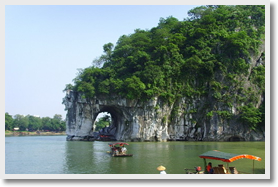
Located by the banks of the Li River, Guilin has gained fame both at home and abroad for its featuring scenery: verdant mountians, unique rockeries, crystal water, various caves, stones of numerous shapes. The many ethnic minorities live here that include the Zhuang, Yao, Hui, Miao, Mulao, Maonan and Dong. They add the much colour to the cultural life of the city.Top attractions in Guilin:
The Li River, The Reed Flute Cave, Elephant Trunk Hill, Seven Star Park, Guilin Folded Brocade Hil, Fubo Hill, Solitary Beauty Hill, Longji Terraced Field in Longsheng, Fengyu Cave in Lipu County Guilin. top
- - - - - - - - - - - - - - - - - - - - - - - - - - - - - - - - - - - - - - - - - - - - - - - - - - - - - - - - - - - - - - - - - - - - - - - - - - - - - - - - - - - - - - -
5. Yangtze River
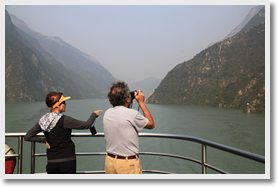
Yangtze River cruising should be on the list for those who seek for romantic escape and travel with their family or friends. Yangtze River is winding through the mountains and the cities from the west to the east entering the East China Sea near Shanghai with a total length of over 6300 km, ranking the third in the world, only shorter than the Nile and Amazon.Top Attractions along Yangtze River:
Chongqing City, Fengdu, Baoshizhai, Wanxian, Shennong Streem, Lesser Three Gorges, Three Gorges, Three Gorges Dam and Yichang City, Wuhan City. top
- - - - - - - - - - - - - - - - - - - - - - - - - - - - - - - - - - - - - - - - - - - - - - - - - - - - - - - - - - - - - - - - - - - - - - - - - - - - - - - - - - - - - - -
6. Lhasa Tibet
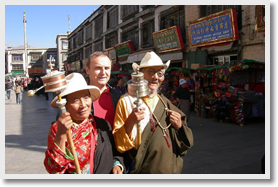
Tibet is a place lonely from the rest of the world with the winding hills of the high plateau and the amazing Himalayas. Today in the age of information, people can easily get to the mysterious place with jet aircraft, highways, now even trains! Lhasa is the political and cultural capital of Tibet. Lhasa means in Tibetan "The land of gods". There are numerous scenic spots and historical sites in Lhasa Tibet.Top Attractions in Tibet:
Potala Palace, Nobulingka, Drepung Monastery, Sera Monastery, Ganden Monastery and Jokhang Temple being the most worth visiting. Shigatse is the second biggest city in Tibet. Shigatse means in Tibetan "The Estate that materializes one's Dream ". Tashilhunpo Monastery is its main historic attraction. Mt. Kailash, in western Tibet is holy to both Hinduism and Buddhism. top
- - - - - - - - - - - - - - - - - - - - - - - - - - - - - - - - - - - - - - - - - - - - - - - - - - - - - - - - - - - - - - - - - - - - - - - - - - - - - - - - - - - - - - -
7. Jiuzhaigou Sichuan
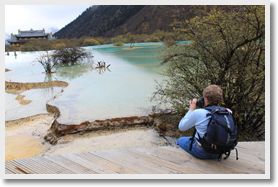
Situated in the depths of the mountains in the border area of Nanping, Songpan and Pingwu counties in Aba Tibetan and Qiang Autonomous Prefecture in the northwestern Sichuan Province, Jiuzhaigou is a fairyland named after the Nine-Village Valley, which is the living place of nine Tibetan villages. The valley is about 50 kilometers long. In 1992, It was listed as the world natural heritage list of UNESCO.Top attractions in Jiuzhaigou Sichuan:
Giant Panda Breeding Research Base, Qingchengshan & Dujiangyan Irrigation System, Emei Mountain and Giant Buddha of Leshan, Jiuzhaigou Scenic Area, Huanglong. top
- - - - - - - - - - - - - - - - - - - - - - - - - - - - - - - - - - - - - - - - - - - - - - - - - - - - - - - - - - - - - - - - - - - - - - - - - - - - - - - - - - - - - - -
8. Lijiang Yunnan
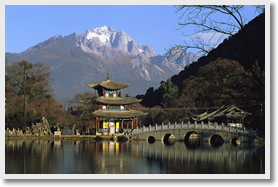
Lijiang is situated in Yunnan Province of south China. It is on UNESCO's World Cultural Heritage list. It has the history of over 1,300 years. Lijiang is inhabited by Naxi people. It is under the administration of the Naxi Autonomous County. It stands on a plateau at 2,600m above sea level. It is well known for its natural scenery and green vegetation. It has the Jade Dragon Mountain as its backdrop. The old town blends naturally with the natural scenery. Thel local Naxi people has developed a culture called "Dong Ba Culture". Classical Naxi music is considered as the "living musical fossil" due to its long history.Top atractions in Lijiang Yunnan:
Ancient Town Lijiang, Yulong Snow Mountain, Tiger Leaping Gorge. top
- - - - - - - - - - - - - - - - - - - - - - - - - - - - - - - - - - - - - - - - - - - - - - - - - - - - - - - - - - - - - - - - - - - - - - - - - - - - - - - - - - - - - - -
9. Zhangjiajie Hunan
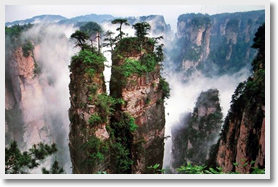
Zhangjiajie City is located on the west mountians of Hunan Province. Under the administration of Zhangjiajie City, there is a district called Wulingyuan District where the Wulingyuan Scenic Area is located. The Wulingyuan Scenic Area is sectioned into 3 parts: Zhangjiajie National Forest Park; Tianzi Mountain and Suoxi Valley. Most of the visitors stay at the Wulingyuan area instead of the city center of Zhangjiajie City. In December of 1992, Wulingyuan was included in the World Heritage List by UNESCO.Top attractions in Zhangjiajie Hunan:
Zhangjiajie National Forest Park, Tianzi Mountain, Suoxi Valley Nature Reserve. top
- - - - - - - - - - - - - - - - - - - - - - - - - - - - - - - - - - - - - - - - - - - - - - - - - - - - - - - - - - - - - - - - - - - - - - - - - - - - - - - - - - - - - - -
10. Silk Road in China
The Silk Road has a history of more than 2,000 years. It actually started from Chang'an ( the present Xian, Shaanxi Province ) in the east and stretched to Rome, Italy in the west. The ancient silk road went through Shaanxi, Gansu, Qinghai provinces, Ningxia Hui and Xinjiang Uygur autonomous regions and then extended over the Pamirs, further extending to Central and West Asia. And finally the silk road met the east bank of the Mediterranean Sea and Eastern Europe. The Silk Road had the total length of over 2,485 miles and over half of which is within China.Top attractions along the Silk Road in China:
Lanzhou, Wuwei, Zhangye, Jiayuguan Pass, Dunhuang, Hami, Turpan, Urumqi, Loulan, Korla, Kuqa (Kucha), Aksu, Kashgar (Kashi), Hotan. top
How to Visit China Top 10
Foreign visitors have many ways to take their sightseeing tours or adventure tours in China. The following methods of traveling are often used by oversea visitors coming to China: 1. Buy a China tour package from a local travel agency based in their own countries.
2. Take an adventure, search all the necessary travel information and arrange the China top 10 tour by yourselves.3. Find a local travel agency based in China to handle all their land arrangement or part of the travel arrangement.
Note:
Usually local travel agencies in China offer two kinds of travel packages: Group tours and private tours.
China Group Tour: Lower prices, less flexibility, make new friends.
China Private Tours: Higher prices, more privacy, more flexibility and more personal interaction.
How to Plan Your China Trip?
1. China Trip PlannerPlease click your resident country or region below to start planning your great trip to China! If your resident country or region is not listed below, please choose "Other Countries and Regions" to plan your China trip. Check China Trip Planner now!
2. What to Bring for China Trip
So you are going to pack your trip to China. If it is your first China tour, you should take some time preparing for your pack for your China trip since China is possibly a world of difference from your resident country.
My short post here is not going to repeat a boring and stereotyped list of things you should bring on your China trip. Rather it is focused on the unique things typical of Chinese customs and culture. Hope it will give you some help having a smooth trip to China.
3. How to get a Chinese visa
Plan your China tour? Any foreign passport holders require a visa in advance of travel to China. A “L” Visa is issued to foreigners who comes to China for travel or visiting family members. There is no visa-on-arrival provision except in extraordinary cases. Chinese visa policy is strictly enforced, and a penalty of RMB 500 per day is imposed for overstaying.
4. Tips on hotel bookings in China
For the past 20 years, the Chinese government has gradually established a fairly effective hotel star rating system which has classified all qualified hotels in China into five categories – Five Star, Four Star, Three Star, Two Star and One Star ( or youth hostels). The higher level of a hotel’s star rating system, the better service and high rates you will expect. But The number of stars of a hotel may not necessarily match its service level.
5. How to recognise Chinese currency
If you are planning your China tour, before you depart for China it is advisable that you have some basic knowledge on how to recognize Chinese currency and identify fake money as well.
China’s legal tender is Renminbi ( Abbreviation: RMB), literally meaning “People’s Money”, issured by the People’s Bank of China. Short official name: CNY (China Yuan), but the short name RMB is also often used. Its symbol: ¥; Monetary unit: Yuan (元) and Fractional units: Jiao (角) and Fen (分).
6. How to use credit cards in China
If you are planning yourChina tours, you may ask ”Can I use a credit card in China and how to use it?”. It is a question which often lingers in the minds of travelers who are going to visit China.
Actually credit cards are widely accepted in bars, restautants and large retail outlets in the major cities in China. Most stores, super markets and hotels in the second tier cities will also accept them. But for remote areas and smaller cities, only cash can be used.
7. How to use ATM in China
Generally speaking, China is a very ATM friendly country, espcially in the large cities such Beijing, Shanghai, Guangzhou, Hongkong, Macao and the list can be much longer. Most of the local ATMs machines accept Visa and Master. CITIBANK card and HSBC are also very popular in China because Citibank and HSBC have agreement with UnionPay. For other cards, you may check the ATMs you are going to use and see if they have the logos and signs for your credit cards. Then how to use ATMs in China?
8.How to Use the toilets in China
Plan your China tour? Are you thinking of how to use toilets in China? Siting or squatting? That is a question for many travelers. Squatting toilets are still quite popular in China. Though it may seem uncomfortable and rather too primitive, the squatting position helps you relax your puborectalis muscle and straightens your rectum, reducing the possibilty of getting constipated and easily having waste exvacuated.
China’s reputation for horrible public bathrooms is quite known. But things are changing to the better now in some big cities like Beijing, Xian Shangai and etc. The local governments in China are doing a lot to improve the state of the toilet facilities. Now you’ll often find public toilets rated with stars.
Most hotels and all majo airports are equipped with sitting toilets with western facilites. But in some tourist spots or remote areas, toliets are not clean and well maintained, no toilet paper, no soap or tissues to dry your hands. Some toilets need repairs which are often clogged with rundown toilet plumbing.
9. How to give a tip in China
Plan your China tour? Do you think of tipping policy in China? To tip or not to tip in China is a question which has confused many foreign visitors. Those against tipping in China argue that China has no tradition of tipping; those for tipping in China think that China is changing and tipping has become more and more popular as a kind of etiquette as well as bonuses for service providers like that in the west.
There are plentiful reasons to disagree or agree with the tipping in China. So it is advisable to avoid meaningless argument over the tipping policy in China. Let’s focus on the present tipping practices existing in China (seeking truth from facts), then regulate our way to deal with the tipping issue properly in China.
10. China Business Hours
Plan your China tour? It is advisable to have some basic knowledge of the working hours and business hours in China to better parpare for your trip.
The Chinese government regulates that Chinese people work 8 hours a day with five working days a week and a maximum 44 working hours a week. In China, business hours are generally set between 9:00am and 6:00pm. But typical business hours vary by different working units and regions.
For government offices, the working hours are often fixed from 8:00am to 5;00pm from Monday to Friday;
Hospitals, banks and post offices are open from 08:30-09:30 to 16:00-18:00. But hospital clinics offer 24 hours service.
11. How to make a phone call in China
So you are planning your China tour and one thing that you should think of, that is how to make a phone call to China from abroad or within China while traveling in China. We have some useful tips for you to get familiar with the rules and methods on your phone calls to and in China.
12. Plugs and sockets in China
Before packing for your China tour, it is necessary to understand the electricity in China, its plugs and socket system as well.
Electricity in China
Basically there are two main standards for voltage and frequency in the world. One is the standard of 120 volts at a frequency of 60 Hz, and the other is the standard of 220–240 volts at 50 Hz. China uses generally 220V, 50HZ, AC (Hong Kong is 200V; Taiwan is 110V).
Converters
If you are from the countries where the standard of 110-120 volts at a frequency of 60 Hz is available, you need to have converters for your electric devices while traveling in China. A converter is a very large implement that converts the input from 220V to 110V or 120V for your device. Most laptops have converters. For small electric devices like hair dryer, electric shaver, it is advisable for you to buy a converter in China or use a free adapter in the hotel.
13. How to Make a Tourist Complaint in China
Plan your China tour? Generally speaking, Chinese people are kind and lenient to foreign visitors. But that doesn’t mean you are always safe and you can lower your vigilance while traveling in China. Like other countries in the world, tourist traps, scams or bad travel experieces also exit here in China.
If you have encountered cheating, forced shopping, fake products, bad experiences with a travel agency, or travel suppliers like flights, trains, scenic spots and hotels, and the list can be longer, you should make a tourist complaint to China Tourism Bureau or its branches in major cities where you are traveling
14. More China Travel Tips
In general, China is a stable country. Our present government has adopted a policy of" Harmony": harmony among people; harmony between human and nature; harmony between the central government and the local and more... China is a pretty safe place for foreign travellers. As a matter of fact, as a foreigner, you will often be given special consideration and a certain amount of leniency. Of course, you have to do according to the law in China and respect the local culture and customs. Hostility toward foreigners is very rare. Most people are friendly and willing to be helpful if possible. To learn more Beijing China travel information, please visit Beijing China Travel Tips. You are also welcome to submit your China travel tips to our tour-beijing travel community to benefit our valuable clients. Thanks in advance!
About the Author
Daniel Li has been in travel business for over 20 years. Now he is the general manager of www.tour-beijing.com. Travel, reading and Internet surfing are among Daniel Li's favorite things to do when he has free time. When it comes to work, Daniel's slogan is: "we no longer just satisfy our valued customers, we must totally impress them."
| Kindly reminder: |
| Questions & Answers: |