

Top 10 Things to do Hangzhou
Hangzhou Trip
Hangzhou Hotels
Hangzhou Car Rental
Hangzhou Tour Guide
Hangzhou Tours
Hangzhou Dining
Hangzhou Shopping
Hangzhou Nightlife
Hangzhou Transportation Hangzhou Climate
Hangzhou Trip
Hangzhou Hotels
Hangzhou Car Rental
Hangzhou Tour Guide
Hangzhou Tours
Hangzhou Dining
Hangzhou Shopping
Hangzhou Nightlife
Hangzhou Transportation Hangzhou Climate
China City Tours
Home → China Travel Guide → Hangzhou Travel Guide
Hangzhou Travel Guide
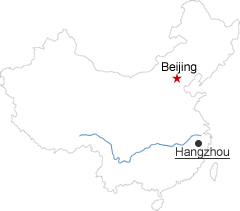
Location: It is situated along the coastal area of East China at the south of the Yangtse Rive Delta.
Population: 7,966,000
Area: 15,984 square kilometers
Nationailities: Han, She, Hui, Manchu, Mongolia, Zhuang, Miao, Korea, Dai, Tibet, Uigur, Russia, Li

History: Hangzhou is famous historical and cultural city in China, reputed as one of the 7 major ancient capitals in the Chinese history.
Hangzhou has a long history and it has been found that fifty thousand years ago the "Jiande people", one of the ancient homo sapiens, lived in this area. In the late Neolithic Period more than five thousand years ago, ancestors of Hangzhou people inhabited the area around the Liangzhu, the northern suburb of the city, and were engaged in primitive agriculture, livestock raising, fishing and hunting. From the Spring and Autumn Period to the Warring States Period, the area was occupied as the territory of Wu, Yue and Chu successively. When Emperor Qin Shihuang defeated all the princes and unified China, this area was established as Qiantang County. The name was changed to Hangzhou during the reign of Emperor Sui Kaihuang and lasted to this day. Established as capital in the periods of the Five Dynasties and the Southern Song Dynasty, and lasting for more than 200 years, Hangzhou saw its height of power and splendor in its history, and was called the "first city in the Southeast China". During the period of Yuan Dynasty, Hangzhou was established as a town of strategic importance, with flourishing economy and beautiful scenery, being, in the words of the Italian traveler Marco Polo, the "most beautiful and luxurious city in the world". In the period of Ming and Qing Dynasties, Hangzhou was still leading the way in economic, social and cultural development in China.
After the founding of the People's Republic of China, Hangzhou became the capital of Zhejiang Province, functioning as the political, economic and cultural center, as well as a transportation hub in the province. With the renowned sight-seeing spot, West Lake, being trimmed and harnessed on an unprecedented scale, Hangzhou has become a famous city for scenery tourism in the world.
Climate: Hangzhou's climate is Humid Subtropical with three distinctive seasons. The average annual temperature in Hangzhou is 16.2�C. The summers are hot and humid, while winters are relatively cool and dry. In July, the hottest month, the average temperature is approximately 33.8�C (92.8�F); in January the average temperature is about 3.6�C (38.5�F). Hangzhou receives an average annual rainfall of 1450 mm. In mid-summer, Hangzhou, along with other cities in Zhejiang province, suffer typhoon storms, but typhoons seldom strike it directly. Generally they make land along the southern coast of Zhejiang, and affect Hangzhou with strong winds and stormy rains.
Transportation: Airline- Hangzhou Xiaoshan International Airport is about 27kms from the center of Hangzhou city, 15kms from Xiaoshan Section. There is a 17.6kms long airport special path connected with Hangzhou city. 126 air-lines both home and abroad are available, covering 59 cities.
Railway- Hangzhou has two main railway stations: New Hangzhou Railway Station and Eastern Railway Station, which are close to the city center.
Highway- Hangzhou is the transportation center of Zhejiang Province. Its coach stations distribute in four directions: the east, the west, the north and the south. Hangzhou railway station offers free bus to the coach stations.
Local Specialities: Hangzhou Silk, Hangzhou Silk Umbrella, Hangzhou Embroidery, Wangxingji Fan, Tianzhu Chopsticks, Longjing Tea
Local Food: West Lake Fish in Vinegar Gravy, Dongpo Pork, Beggar’s Chicken, Shrimp Meat with Longjing Tea, Hangzhou Catsup Duck, Glutinous Rice Ball in Fermented Rice Wine, West Lake Water Shield Soup
Here is only for Questions and Answers. ( For anyone who wants to have an enquiry or tour booking, please fill in our Online Enquiry. )
Hangzhou Travel Guide
| Transportation | Hangzhou Hotels | Hangzhou Attractions |
| Hangzhou Nightlife | Hangzhou Shopping | Hangzhou Food |
Location: It is situated along the coastal area of East China at the south of the Yangtse Rive Delta.
Population: 7,966,000
Area: 15,984 square kilometers
Nationailities: Han, She, Hui, Manchu, Mongolia, Zhuang, Miao, Korea, Dai, Tibet, Uigur, Russia, Li

History: Hangzhou is famous historical and cultural city in China, reputed as one of the 7 major ancient capitals in the Chinese history.
Hangzhou has a long history and it has been found that fifty thousand years ago the "Jiande people", one of the ancient homo sapiens, lived in this area. In the late Neolithic Period more than five thousand years ago, ancestors of Hangzhou people inhabited the area around the Liangzhu, the northern suburb of the city, and were engaged in primitive agriculture, livestock raising, fishing and hunting. From the Spring and Autumn Period to the Warring States Period, the area was occupied as the territory of Wu, Yue and Chu successively. When Emperor Qin Shihuang defeated all the princes and unified China, this area was established as Qiantang County. The name was changed to Hangzhou during the reign of Emperor Sui Kaihuang and lasted to this day. Established as capital in the periods of the Five Dynasties and the Southern Song Dynasty, and lasting for more than 200 years, Hangzhou saw its height of power and splendor in its history, and was called the "first city in the Southeast China". During the period of Yuan Dynasty, Hangzhou was established as a town of strategic importance, with flourishing economy and beautiful scenery, being, in the words of the Italian traveler Marco Polo, the "most beautiful and luxurious city in the world". In the period of Ming and Qing Dynasties, Hangzhou was still leading the way in economic, social and cultural development in China.
After the founding of the People's Republic of China, Hangzhou became the capital of Zhejiang Province, functioning as the political, economic and cultural center, as well as a transportation hub in the province. With the renowned sight-seeing spot, West Lake, being trimmed and harnessed on an unprecedented scale, Hangzhou has become a famous city for scenery tourism in the world.
Climate: Hangzhou's climate is Humid Subtropical with three distinctive seasons. The average annual temperature in Hangzhou is 16.2�C. The summers are hot and humid, while winters are relatively cool and dry. In July, the hottest month, the average temperature is approximately 33.8�C (92.8�F); in January the average temperature is about 3.6�C (38.5�F). Hangzhou receives an average annual rainfall of 1450 mm. In mid-summer, Hangzhou, along with other cities in Zhejiang province, suffer typhoon storms, but typhoons seldom strike it directly. Generally they make land along the southern coast of Zhejiang, and affect Hangzhou with strong winds and stormy rains.
Transportation: Airline- Hangzhou Xiaoshan International Airport is about 27kms from the center of Hangzhou city, 15kms from Xiaoshan Section. There is a 17.6kms long airport special path connected with Hangzhou city. 126 air-lines both home and abroad are available, covering 59 cities.
Railway- Hangzhou has two main railway stations: New Hangzhou Railway Station and Eastern Railway Station, which are close to the city center.
Highway- Hangzhou is the transportation center of Zhejiang Province. Its coach stations distribute in four directions: the east, the west, the north and the south. Hangzhou railway station offers free bus to the coach stations.
Local Specialities: Hangzhou Silk, Hangzhou Silk Umbrella, Hangzhou Embroidery, Wangxingji Fan, Tianzhu Chopsticks, Longjing Tea
Local Food: West Lake Fish in Vinegar Gravy, Dongpo Pork, Beggar’s Chicken, Shrimp Meat with Longjing Tea, Hangzhou Catsup Duck, Glutinous Rice Ball in Fermented Rice Wine, West Lake Water Shield Soup
| Questions & Answers: |