



Traditional Chinese Art
Traditional Chinese Painting – Chinese CultureTraditional Chinese painting is the art of painting on a piece of Xuan paper or silk with a Chinese brush that was soaked with black ink or colored pigments. It is regarded as one of the “three quintessence of Chinese culture”, the other two being traditional Chinese medicine and Beijing Opera.
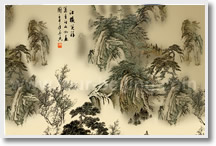
By object, traditional Chinese painting can be classified into three types, figure painting, landscape painting, and flowers and birds painting.
Figure painting came into maturity as early as the Warring State Period (475-221) and reached its peak during the Tang Dynasty (618-907). Famous figure painting artists include Gu Kaizhi and Wu Daozi.
Landscape painting, as the name indicates, delineates the outside scenery. It first appeared in the Qin Dynasty (221BC-206BC) and became an independent genre during the Sui (581-618) and Tang dynasties. By the time of Song Dynasty (960-1279), it had reached a very high level.
Flowers and birds painting concentrates on the drawing of flowers, birds, animals, fishes, and insects, etc. in their natural state. It came into being in the Northern and Southern dynasties (420-589) and became a mature art during the Song Dynasty.
In a finished works of traditional Chinese painting, inscriptions, poems and stamps oftern come side by side. Therefore, traditional Chinese painting is an art form combining poetry, calligraphy, painting and seal carving.
Its artistic achievement and national features have won recognition of the people all over the world. Thus, traditional Chinese painting brings decorous sentiment and artistic enjoyment for people.
Quyi – Chinese Culture
Quyi is a general term for all kinds of talking and singing arts. It derived from oral literature, the talking and singing performance of ancient people. It refers primarily to story telling accenturated by body movements to tell stories, express feelings and reflect the social conditions.
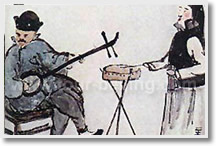
There are still about 300 types of quyi being performed in China, including comic dialogue, dagu, kuaiban, errenzhuan, tanci, shuanghuang. Of course, the most popular is comic dialogues.
Comic dialogues is a kind of folk art with the “comic”dialogue as the main form of performance. It evolved on the basis of ancient folk jokes. Comic dialogue of tody originated in Beijng and Tianjin over a century ago.
Comic dialogue realized its aritstic presentation by means of talking, imitatin, teasing,and singing. The jokes are skillfully hidden in the baofu. When the right time comes, they are suddenly spilled out, just like the funny stuffs being tossed out of a carefully wrapped package.
Most of the comic dialogue stories come from daily life. Others are based on folk jokes, historical legends, events, and word games.
Local Operas – Chinese Culture
China is a country with vast land and varioius nationalities. People in different regions speak different dialects. As as result, many local opera forms have appeared alongside Beijing Opera.
Statistics show that there are more than 360 types of local operas, of which the best-known are Pingju Opera, yue or Shaoxing Opera, Yu or Henan Opera, Huangmei Opera, Guangdong Opera, and Sichuan Opera, etc.
Pingju Opera originated in Tangshan city, Hebei Province and is popular in Beijng, Tiajin, North and Nurtheast of China, Pingju Opera is lively, free in style and close to life. It is a perfect form ot reflect the modern life.
Yue or Shaoxing Opera originated in Shaoxing of Zhejiang Province. The tunes of the opera ae mild and roundabout, and the acting is meticulous. It became the second largest opera form next to Beijing Opera.
Yu or Henan Opera is the local opera of Henan Province and prevalent in Henan and neighboring areas. Yu Opera is played wit a bright, loud sound, alternating with sorrowful tone. There are more about 650 traditonal plays.
Huangmei Opera is the local opera of Anhui Province and is popular in Anhui and Jiangxi Province. This opera is characterized by dancing while singing. Its tunes are mild and pleasant, and its movements are natual and graceful. It is also very close to real life.
Guangdong Opera is the local opera form of Guangdong Province and is also popular in Guangxi Province. Overseas Chinese in Southeast Asian, America, Europe and Oceania, and the people of Hongkong and Macao SARs are also very fond of this type of local opera. Guangdong Opera is sung with the Cantonese dilect and is rather unique in its singing style.
Beijing Opera – Chinese Culture
Beijing Opera is th most popular and influential opea in China with a history of almost 200 years. Beijing Opera combines singing, recital, acting and acrobatic fighting. Singing refers to the singing according to certain tunes.
Recial refers to monologues by performers and dialogues between performers. Acting refers to boday movements and facial expressions. Acrobatic fighting refers to choreographed martial art.
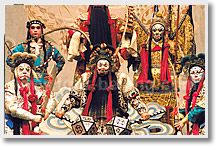
In the long term of developemnt, Beijing Opera has formed a number of fictitious props. For instance, a pedal means a boat, a whip in the hand means riding on a hourse. Without any physical props involved, an actor may perform going upstairs or downstairs, opening or closing a door by mere gesture. Thought rather exaggerated, those actions would, with their graceful movements, give audience a deep impression.
There are four main roles in Beijing Opera: sheng, dan, jing and chou. Sheng are the leading male actors, and are divided into laosheng who wear breads and represent old men, xiaosheng who represent young men, and wusheng who are acrobats playing military men and fighters.
Dan are female roles. Formerly, the term meant femal impersonators. It is further divided into several categories. The most important category, qingyi, usually play respectable and decent ladies in elegant costumes. Huadan represent lively and clever young girls, usually in short costumes. Wudan usually play military or non-military women capable of marrial arts. Laodan are the old ladies.
Facial makeup in Beijng Opera has its own pattern. A sheng or dan has to have its or her eyebrows painted in a way that they look slanted with the outer ends of eyebrows going upwasrd, and their eyes circled with black color.
As for a jing and chou, the pattern is in accordance with the dispositon of the characters according to the rule of facial makeup in Beijng Opera. It is said that the complete Beijing Opera repertoire includes more than 3,800 plays.
Beijing Opera, as the national opera, enjoys a high reputation both inside and outside China. Many foreigner have come to China to learn Beijing Opera, while many Beijng Opera acotrs and actresses have frequetely been invited to perform abroad and have been highly appreciated by foreign audience.
Folk Music – Chinese Culture
Chinese folk music, with strong nationalistic features, is a treasure of Chinese culture.
As early as in the primitive times, Chinese people began to use musical instrument, which evolved today into four main types categorized by the way they are played. The first type is wind instrument, as shown in xiao (a vertical bamboo flute), flute, suona horn, etc.
The second type is string instrument, represented by urheen, jinghu, banhu fiddle, etc. The third type is also string instrument, but played unconventionally by striking the strings with fingers, represented by guzheng, guqin, pipa, etc. The fourth type is percussion instrument, as seen usually in going, drum, etc.
For centuries, Chinese musicians have created numerous excellent songs and lyrics, but, unfortunately, many were lost.
Chinese people love folk music for its unique charm. In China, almost every region has its own folk music troupes, some of which are self-organized by folk music fans. Chinese folk music troupes are often invited to perform internationally.
In recent years, they have been invited to visit Vienna-the world music capital, and perform in the famous G olden Hall during the Chinese Spring Festival. The pleasant melodies not only impress the local audiences, but also win international popularity.
Questions & Answers:
 Here is only for Questions and Answers. ( For anyone who wants to have an enquiry or customized tour, please email us to
  . )
. )