



Beijing Xian Day Tour
China Private Tours
China Group Tours
Yangtze River Cruises
Beijing Lhasa Tibet Tour
China Silk Road Tour
China Train Tours
Xian Tour, Xian Tours
Shanghai Tours
Guilin Tour, Guilin Tours

China Private Tours
China Group Tours
Yangtze River Cruises
Beijing Lhasa Tibet Tour
China Silk Road Tour
China Train Tours
Xian Tour, Xian Tours
Shanghai Tours
Guilin Tour, Guilin Tours

Enquiry, Tour Quotation, Booking, Way of Payment, Exchange Rate, Individual Travel, Group Travel, Hotels, Transportation,
Restaurants, Cancellation,
Insurance, Liability...
Dear Ms. Mary Ma,
I am back from China now and would like to take a moment out of my busy schedule to let you know that your company and your guide Rogin Lee are fantastic. Rogine made my tour of China, his depth of knowledge is incredible and his presentations and introductions were indepth and interesting. Rogin presented China's past and present in a new light. This China tour with Rogin surpassed what I was expecting from any China tour company. I would like to extend my thanks to yourself, Rogin Lee and Mr. Wong, the driver.
Sincerely,
Lee A. Gravesen
lee@directdoor.com
I am back from China now and would like to take a moment out of my busy schedule to let you know that your company and your guide Rogin Lee are fantastic. Rogine made my tour of China, his depth of knowledge is incredible and his presentations and introductions were indepth and interesting. Rogin presented China's past and present in a new light. This China tour with Rogin surpassed what I was expecting from any China tour company. I would like to extend my thanks to yourself, Rogin Lee and Mr. Wong, the driver.
Sincerely,
Lee A. Gravesen
lee@directdoor.com
You will be updated with the
little and common things often
unseen by the real foreign
travelers in their trips to
Beijing China. Also send
your Beijing China travel
blogs to us and have your
blog posted for others to share.
Beijing China travelogues
from the clients having
used our Beijing China
travel service from all
over the world, with happily
slanted insights! Copious
photos and travel Reviews
and travel tips plus inside
tour information.
Are you expecting a Beijing
China trip advisor to design
a tailor-made Beijing China
holiday tour package?
We offer free Beijing China travel
advice as well as arranging
your guided Beijing China tour.
Are you looking for a resourceful
and helpful Beijing tour guide?
With most of them university
graduates, our Beijing tour guides
have received very good professional
training in hospitality industry.
We have arranged yummy
Chinese lunches and dinners
at nice restaurants during
your trip in Beijing China.
Very often we skip the dinners,
but we do include lunches in your
Beijing China tour packages.
Usually you can have a relaxing
dinner on your own at your hotel a
fter a day's tiring sightseeing.
What are you expecting for
the tourist vehicles in Beijing
China for your sightseeing or
your business? We are committed
to offer you the quality service
you need when you come to
Beijing China either as a
visitor or businessman.
We provide comfortable
vehicles like sedan, limousine,
van & coach services per your request.
Online Booking Steps
1. Select a tour & submit
Browser a tour that most suits you and send us the tour with your custom request.
2. Quote for your tour
Receive our tour proposal with rates in one working day.
3. Adjust your tour
Modify your itinerary with new quotes for free until it fits you.
4. Confirm & deposit
Finalise your tour after receiving your deposit.
5. Final payment
Pay the balance before or upon arrival.
Browser a tour that most suits you and send us the tour with your custom request.
2. Quote for your tour
Receive our tour proposal with rates in one working day.
3. Adjust your tour
Modify your itinerary with new quotes for free until it fits you.
4. Confirm & deposit
Finalise your tour after receiving your deposit.
5. Final payment
Pay the balance before or upon arrival.
Home → China Travel Guide → China Facts → Chinese Architecture
Chinese Architecture
Modern Architecture – Chinese Folklore
As with many other elements of the Chinese culture, tradition has been interwoven with modern technology. Although many traditional buildings still exist, almost all new buildings are built in Western style. It is not uncommon to see skyscrapers in a large city of China. Traditional houses, however, are still exquisitely built.
Traditional Architecture – Chinese Folklore
Ancient Chinese architecture enjoys a long history and great achievements, and created many architectural miracles such as the Great Wall. In the process of its development, superior architectural techniques and artistic design were combined to make unique Chinese architecture one of the three greatest architectural systems.
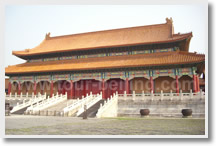
The combination of units of space in traditional Chinese architecture follow the principles of balance and symmetry. The main structure is the axis, and the secondary structures are positioned as two wings on each side to form the main rooms and yard.
Residence, official buildings, temples, and palaces all follow these basic principles. The distribution of interior space reflects Chinese social and ethical values. For instance, in traditional residential buildings, members of a family are assigned living quarters based on the family hierarchy. The master of the house occupies the main room, and the elder members of the master’s family live in the compound in the back. The younger member of the family live in the wings to the left and right; those with seniority on the left and the others on the right.
Another characteristic of traditional Chinese architecture is its use of a wooden structural framed with pillars, beams, and earthen walls surrounding the building on three sides. The main door and windows are in front. Chinese have used wood as a main construction material for thousands o years; wood to the Chinese represents life, and “life” is the main idea that Chinese culture strives to communicate. This feature has been preserved up to the present.
Based on the structure of the wooden beams and pillars, traditional Chinese rectangular buildings are divided into several rooms. In order to cover the structure with an over-hanging roof, the Chinese invented a special type of support bracket, called toukung, which both supports the structure and is an attractive ornamentation.
Roofs usually slope down on both sides in a simple fashion. However, many traditional Chinese buildings have curved eaves. The characteristic curve of Chinese roofs is symbolic of the spirit of Chinese culture. While the building itself is relatively plain and straightforward, the ridge and eaves of the roof introduce a more intricate aspect in the form of upward-curving eaves. This is analogous to the Chinese national character which is by nature plain and straightforward but full of vitality.
Timber framework decides that color is the main ornament used on ancient Chinese architecture. In the beginning, paint was used on wood for antisepsis while later painting became on architectural ornament.
In the feudal society, the use of color was restricted according to strict social status classification. Since yellow was deemed noblest color and green the second, they were often applied on palace painting, which was called Hexicaihua in Chinese.
The sundry color murals found on a traditional of myths to paintings of landscapes, flowers, and birds. Clearly these color murals have both symbolic and particularity in Taiwan, is fine wood sculpture. Such sculptures coupled with murals give the structure an elegant and florid effect under the background of while granite basement.
Chinese Architecture
Modern Architecture – Chinese Folklore
As with many other elements of the Chinese culture, tradition has been interwoven with modern technology. Although many traditional buildings still exist, almost all new buildings are built in Western style. It is not uncommon to see skyscrapers in a large city of China. Traditional houses, however, are still exquisitely built.
Traditional Architecture – Chinese Folklore
Ancient Chinese architecture enjoys a long history and great achievements, and created many architectural miracles such as the Great Wall. In the process of its development, superior architectural techniques and artistic design were combined to make unique Chinese architecture one of the three greatest architectural systems.

The combination of units of space in traditional Chinese architecture follow the principles of balance and symmetry. The main structure is the axis, and the secondary structures are positioned as two wings on each side to form the main rooms and yard.
Residence, official buildings, temples, and palaces all follow these basic principles. The distribution of interior space reflects Chinese social and ethical values. For instance, in traditional residential buildings, members of a family are assigned living quarters based on the family hierarchy. The master of the house occupies the main room, and the elder members of the master’s family live in the compound in the back. The younger member of the family live in the wings to the left and right; those with seniority on the left and the others on the right.
Another characteristic of traditional Chinese architecture is its use of a wooden structural framed with pillars, beams, and earthen walls surrounding the building on three sides. The main door and windows are in front. Chinese have used wood as a main construction material for thousands o years; wood to the Chinese represents life, and “life” is the main idea that Chinese culture strives to communicate. This feature has been preserved up to the present.
Based on the structure of the wooden beams and pillars, traditional Chinese rectangular buildings are divided into several rooms. In order to cover the structure with an over-hanging roof, the Chinese invented a special type of support bracket, called toukung, which both supports the structure and is an attractive ornamentation.
Roofs usually slope down on both sides in a simple fashion. However, many traditional Chinese buildings have curved eaves. The characteristic curve of Chinese roofs is symbolic of the spirit of Chinese culture. While the building itself is relatively plain and straightforward, the ridge and eaves of the roof introduce a more intricate aspect in the form of upward-curving eaves. This is analogous to the Chinese national character which is by nature plain and straightforward but full of vitality.
Timber framework decides that color is the main ornament used on ancient Chinese architecture. In the beginning, paint was used on wood for antisepsis while later painting became on architectural ornament.
In the feudal society, the use of color was restricted according to strict social status classification. Since yellow was deemed noblest color and green the second, they were often applied on palace painting, which was called Hexicaihua in Chinese.
The sundry color murals found on a traditional of myths to paintings of landscapes, flowers, and birds. Clearly these color murals have both symbolic and particularity in Taiwan, is fine wood sculpture. Such sculptures coupled with murals give the structure an elegant and florid effect under the background of while granite basement.