



Beijing Xian Day Tour
China Private Tours
China Group Tours
Yangtze River Cruises
Beijing Lhasa Tibet Tour
China Silk Road Tour
China Train Tours
Xian Tour, Xian Tours
Shanghai Tours
Guilin Tour, Guilin Tours

China Private Tours
China Group Tours
Yangtze River Cruises
Beijing Lhasa Tibet Tour
China Silk Road Tour
China Train Tours
Xian Tour, Xian Tours
Shanghai Tours
Guilin Tour, Guilin Tours

Enquiry, Tour Quotation, Booking, Way of Payment, Exchange Rate, Individual Travel, Group Travel, Hotels, Transportation,
Restaurants, Cancellation,
Insurance, Liability...
Dear Ms. Mary Ma,
I am back from China now and would like to take a moment out of my busy schedule to let you know that your company and your guide Rogin Lee are fantastic. Rogine made my tour of China, his depth of knowledge is incredible and his presentations and introductions were indepth and interesting. Rogin presented China's past and present in a new light. This China tour with Rogin surpassed what I was expecting from any China tour company. I would like to extend my thanks to yourself, Rogin Lee and Mr. Wong, the driver.
Sincerely,
Lee A. Gravesen
lee@directdoor.com
I am back from China now and would like to take a moment out of my busy schedule to let you know that your company and your guide Rogin Lee are fantastic. Rogine made my tour of China, his depth of knowledge is incredible and his presentations and introductions were indepth and interesting. Rogin presented China's past and present in a new light. This China tour with Rogin surpassed what I was expecting from any China tour company. I would like to extend my thanks to yourself, Rogin Lee and Mr. Wong, the driver.
Sincerely,
Lee A. Gravesen
lee@directdoor.com
You will be updated with the
little and common things often
unseen by the real foreign
travelers in their trips to
Beijing China. Also send
your Beijing China travel
blogs to us and have your
blog posted for others to share.
Beijing China travelogues
from the clients having
used our Beijing China
travel service from all
over the world, with happily
slanted insights! Copious
photos and travel Reviews
and travel tips plus inside
tour information.
Are you expecting a Beijing
China trip advisor to design
a tailor-made Beijing China
holiday tour package?
We offer free Beijing China travel
advice as well as arranging
your guided Beijing China tour.
Are you looking for a resourceful
and helpful Beijing tour guide?
With most of them university
graduates, our Beijing tour guides
have received very good professional
training in hospitality industry.
We have arranged yummy
Chinese lunches and dinners
at nice restaurants during
your trip in Beijing China.
Very often we skip the dinners,
but we do include lunches in your
Beijing China tour packages.
Usually you can have a relaxing
dinner on your own at your hotel a
fter a day's tiring sightseeing.
What are you expecting for
the tourist vehicles in Beijing
China for your sightseeing or
your business? We are committed
to offer you the quality service
you need when you come to
Beijing China either as a
visitor or businessman.
We provide comfortable
vehicles like sedan, limousine,
van & coach services per your request.
Online Booking Steps
1. Select a tour & submit
Browser a tour that most suits you and send us the tour with your custom request.
2. Quote for your tour
Receive our tour proposal with rates in one working day.
3. Adjust your tour
Modify your itinerary with new quotes for free until it fits you.
4. Confirm & deposit
Finalise your tour after receiving your deposit.
5. Final payment
Pay the balance before or upon arrival.
Browser a tour that most suits you and send us the tour with your custom request.
2. Quote for your tour
Receive our tour proposal with rates in one working day.
3. Adjust your tour
Modify your itinerary with new quotes for free until it fits you.
4. Confirm & deposit
Finalise your tour after receiving your deposit.
5. Final payment
Pay the balance before or upon arrival.
Home → China Travel Guide → China Facts → China's Traditional Clothing
China's Traditional Clothing
Today’s clothing — Chinese Folklore
China’s fashion designers use a mixture of traditional and modern ideas to create new fashions. These new fashions also incorporate age-old motifs such as guardian deities, lions, and masks of Chinese opera characters.
Chinese bronze is another source of printed, woven, and embroidered design for clothes. Some of the distinctive designs include dragons, phoenixes, clouds, and lighting.
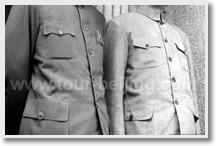
In modern society, Chinese men are seen at social occasions wearing ceremonial clothes in two varieties on formal occasions, i.e. the dignified and refined traditional Chinese long gown and the SunYat-sen’s uniform, which is a creative blending of fashion elements from the East and West, and a milestone in the history of Chinese garment design-was hailed as the “State Suit”.
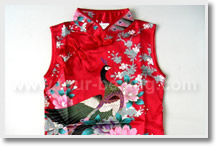
While women often wear the ch’i-p’ao. The variations of height, length, width, and ornamentation of the collar, sleeves, skirt, and basic cut of this Oriental fashion are limitless. Are
Changes of Men’s and Women’s Costume — Chinese Folklore
Men wore western-style clothes and Sun Yat-sen’s uniform (Chinese tunic suit). These two style of clothes were foreign styles, and most officials and intellectuals more usually wore them. White garments were worn in summer, but black or dark ones in other seasons.
The style with a mandarin jacket over a long gown was still one of the common dressing styles. The student’s clothing with erect collars, three pockets and seven buttons were mainly the uniform of students of universities and colleges. In addition, typical clothes of rural men and women included a jacket and trousers or covered with a ramie skirt.
Women’s costume changed greatly during the period, some kept the Qing Dynasty (1644-1912) style of trousers and clothes with curving front, some imitated western-style with a jacket and a skirt, most schoolgirls wore black silk skirts and short jackets that had a round lower hem and short sleeves to elbow. The common garments of social women were manly Chi-pao.
In the 1920s, people began to wear Chi-pao whose style was mostly the same as that of the Qizhuang existing at the end of Qing Dynasty. Later, the cuff was reduced gradually, and embroidered border was not as broad as the previous one. By the early 1930s, Chi-pao had been very popular.
The main changes of garments in that time were the modifications of collar, sleeve and length, etc. The garments with high collar were popular first, and the higher the collar, the more popular. Gradually, garments with low collars began to be popular, and the lower the collar, the more modern. Finally, people wore collarless and sleeveless Chi-pal.
Chinese’s Modern Clothing — Chinese Folklore
After the 1911 Revolution, the garments changed greatly, and the dresses and the official cap were eliminated. Particularly, hair plaits were cut off, but chi-pao still exist. The Blue Short Gown of schoolgirls was the main style, and it gradually became popular.
The government specified the system of formal dresses of men and women in the first year of the Republic of China. Men had dress suits and routine suits. Dress suits included day suit and evening suits, which were all made of black cloth, trousers and cravats. Routine suits included Western style and Chinese style (e.g. long gown and mandarin jacket). The formal dress of women had collars and was long to the knees with buttons down the front. Skirt were decorated with cartouches in the front and back, both sides were sewn with pleats, and both ends had patterns of knots.
Along with the emergence of cinema, film stars became eminent figures gradually. Shanghai City became the base camp of women’s wear in China. The garments of Guangdong Province and Hong Kong became one of the branches of Shanghai City garments.
China’s Ancient Clothing — Chinese Folklore
China’s traditional clothing is characterized as magnificent. An outstanding characteristic of traditional Chinese clothing is not only an external expression of elegance, but also an internal symbolism. Each and every piece of traditional clothing communicates a sense of external form with internal symbolism of clothing is clearly exemplified in the pair of fighting pheasant feathers used in head wear originating in the battle wear of the Warring States period (457-221BC).
The three main types of traditional Chinese clothing are the pien-fu, the ch’ang-p’ao, and the shen-i. The pien-fu is an ancient two-piece ceremonial costume of a tunic-like top extending dto the knees and a skirt or trousers extending to the ankles. The Ch’ang-p’ao is a one –piece garment extending from the shoulders all the way to the heels. The shen-i is a cross between the pien-fu and the ch’ang –pao.
Consequently, the shen-i was the most widely worn o the three types. Typical of these three types of clothing were wide and voluminous sleeves and a very loose fit. So because of their relatively plain design and structure, embroidered edgings, decorated bands, draped cloth or skills, patterns on the shoulder, and sashes were often added as ornaments. Variety in designs came to be one of the unique features of traditional Chinese dress.
Darker colors were favored over lighter ones in traditional Chinese clothing, so the main color of ceremonial clothing tended to be dark while bright, elaborate tapestry designs was worn more frequently by the common people for everyday life and around the house use. The Chinese associate certain colors with specific seasons: green represents spring, red symbolizes summer, white represents autumn, and black symbolizes winter. The Chinese are said to have a fully developed system of matching, coordinating, and contrasting colors in apparel.
China's Traditional Clothing
Today’s clothing — Chinese Folklore
China’s fashion designers use a mixture of traditional and modern ideas to create new fashions. These new fashions also incorporate age-old motifs such as guardian deities, lions, and masks of Chinese opera characters.
Chinese bronze is another source of printed, woven, and embroidered design for clothes. Some of the distinctive designs include dragons, phoenixes, clouds, and lighting.
In modern society, Chinese men are seen at social occasions wearing ceremonial clothes in two varieties on formal occasions, i.e. the dignified and refined traditional Chinese long gown and the SunYat-sen’s uniform, which is a creative blending of fashion elements from the East and West, and a milestone in the history of Chinese garment design-was hailed as the “State Suit”.
While women often wear the ch’i-p’ao. The variations of height, length, width, and ornamentation of the collar, sleeves, skirt, and basic cut of this Oriental fashion are limitless. Are
Changes of Men’s and Women’s Costume — Chinese Folklore
Men wore western-style clothes and Sun Yat-sen’s uniform (Chinese tunic suit). These two style of clothes were foreign styles, and most officials and intellectuals more usually wore them. White garments were worn in summer, but black or dark ones in other seasons.

The style with a mandarin jacket over a long gown was still one of the common dressing styles. The student’s clothing with erect collars, three pockets and seven buttons were mainly the uniform of students of universities and colleges. In addition, typical clothes of rural men and women included a jacket and trousers or covered with a ramie skirt.
Women’s costume changed greatly during the period, some kept the Qing Dynasty (1644-1912) style of trousers and clothes with curving front, some imitated western-style with a jacket and a skirt, most schoolgirls wore black silk skirts and short jackets that had a round lower hem and short sleeves to elbow. The common garments of social women were manly Chi-pao.
In the 1920s, people began to wear Chi-pao whose style was mostly the same as that of the Qizhuang existing at the end of Qing Dynasty. Later, the cuff was reduced gradually, and embroidered border was not as broad as the previous one. By the early 1930s, Chi-pao had been very popular.
The main changes of garments in that time were the modifications of collar, sleeve and length, etc. The garments with high collar were popular first, and the higher the collar, the more popular. Gradually, garments with low collars began to be popular, and the lower the collar, the more modern. Finally, people wore collarless and sleeveless Chi-pal.
Chinese’s Modern Clothing — Chinese Folklore
After the 1911 Revolution, the garments changed greatly, and the dresses and the official cap were eliminated. Particularly, hair plaits were cut off, but chi-pao still exist. The Blue Short Gown of schoolgirls was the main style, and it gradually became popular.

The government specified the system of formal dresses of men and women in the first year of the Republic of China. Men had dress suits and routine suits. Dress suits included day suit and evening suits, which were all made of black cloth, trousers and cravats. Routine suits included Western style and Chinese style (e.g. long gown and mandarin jacket). The formal dress of women had collars and was long to the knees with buttons down the front. Skirt were decorated with cartouches in the front and back, both sides were sewn with pleats, and both ends had patterns of knots.
Along with the emergence of cinema, film stars became eminent figures gradually. Shanghai City became the base camp of women’s wear in China. The garments of Guangdong Province and Hong Kong became one of the branches of Shanghai City garments.
China’s Ancient Clothing — Chinese Folklore
China’s traditional clothing is characterized as magnificent. An outstanding characteristic of traditional Chinese clothing is not only an external expression of elegance, but also an internal symbolism. Each and every piece of traditional clothing communicates a sense of external form with internal symbolism of clothing is clearly exemplified in the pair of fighting pheasant feathers used in head wear originating in the battle wear of the Warring States period (457-221BC).
The three main types of traditional Chinese clothing are the pien-fu, the ch’ang-p’ao, and the shen-i. The pien-fu is an ancient two-piece ceremonial costume of a tunic-like top extending dto the knees and a skirt or trousers extending to the ankles. The Ch’ang-p’ao is a one –piece garment extending from the shoulders all the way to the heels. The shen-i is a cross between the pien-fu and the ch’ang –pao.
Consequently, the shen-i was the most widely worn o the three types. Typical of these three types of clothing were wide and voluminous sleeves and a very loose fit. So because of their relatively plain design and structure, embroidered edgings, decorated bands, draped cloth or skills, patterns on the shoulder, and sashes were often added as ornaments. Variety in designs came to be one of the unique features of traditional Chinese dress.
Darker colors were favored over lighter ones in traditional Chinese clothing, so the main color of ceremonial clothing tended to be dark while bright, elaborate tapestry designs was worn more frequently by the common people for everyday life and around the house use. The Chinese associate certain colors with specific seasons: green represents spring, red symbolizes summer, white represents autumn, and black symbolizes winter. The Chinese are said to have a fully developed system of matching, coordinating, and contrasting colors in apparel.