


China Train Timetable & Tickets Booking
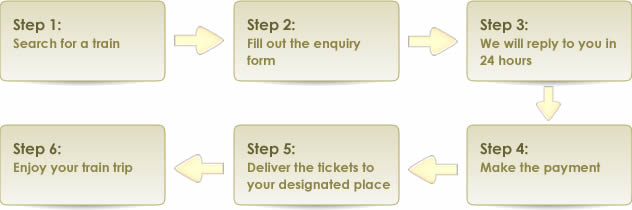
China Train Ticket Booking Process
TRAIN SEARCH: All the domestic trains are daily ones unless specially indicated.
| - - - - - - - - - - - - - - - - - - - - - - - - - - - - - - - - - - - - - - - - - - - - - - - - - - - - - - - - - - - - - - - - - - - - - - - - - - - - - - - - - - - - |
Please be advised that the train information is for your reference only.
| China Train Tours | |
 |
Tour China by Rail! China is a country of trains. Taking trains is one of the most cheapest, safest and exotic way of travelling in Beijing China. Beijing Xian Day Tour by Train from US$250 p/p Beijing Xian Shanghai 8 Day Rail Tour from US$825 p/p Shanghai Beijing Bullet Train 7 Day Tour grom US$1330 p/p Shanghai Xian Beijing 9 Day Rail Tour from US$825 p/p Xining Lhasa 7 Days Train Tour from US$ p/p Chengdu Chongqing Yangtze River 8 Day Tour with Bullet Train Experience from US$1055 p/p Beijing Xian Day Tour by Train from US$250 p/p Beijing Xian Shanghai 8 Day Rail Tour from US$825 p/p Shanghai Beijing Bullet Train 7 Day Tour grom US$1330 p/p Shanghai Xian Beijing 9 Day Rail Tour from US$825 p/p Xining Lhasa 7 Days Train Tour from US$ p/p Chengdu Chongqing Yangtze River 8 Day Tour with Bullet Train Experience from US$1055 p/p |
7 Types of Trains in China
G Train: "G" is the first letter of "Goasu", literally meaning "High Speed"(EMU). This refers to a group of long-distance high-speed trains. G1-G5998 is designated for the trains that are used in more than one railway bureau's zone, while G6001-G9998 run only within one railway bureau's area. The whole railway in China is managed by several railway bureaus headquatered in different parts of China.
C Train: C Train at present only refers to the bullet express passenger train running between Beijing and Tianjin designed with the highest speed of 250 -300 km. This Beijing-Tianjin bullet train features cleanness, low noise, elegant-looking and speed. Now C typle train is the fastest of this kind in operation around the world.
D Train: D Train refers to "China Railway High-speed (CRH)" in English, a kind of China styled Bullet Train. This kind of train is the most modern and advanced train in China at present. The "D Train" of this kind is likened to "Multiple Unit"(MU) in English. It can reach 200-350km/h. Usually it offers the First class seat and Second class seat. It is clean and comfortable, and the inside of the train is quite different from the other trains. All the seats face the same way. There is a screen that shows how fast the train is going.
Z Train: Z Train refers to "Thorough Express Train" in English. Z Train is the most popular and important in China. It is a thorough train without any stops on routes before getting to the destination. This kind of train usually runs between big cities ( capital cities of provinces ). Most of the Z Trains start in the evening and reach the destination in the next morning and overnight on the train. The train has two-bed cabins and 4-bed cabins both for soft sleeper and hard sleeper tickets. This kind of train also offers hard seats, popular among Chinese local travellers. The train has air-conditioned system, hot water, western styled toilet. There is a restaurant car on the train to serve three meals.
T Train: T Train refers to "Express Train" in English. Unlike "Thorough Express Train", this kind of train stops at important big cities on route before reaching the destination. So T Train is usually more crowded than Z Train. Its tickets are composed of hard seat, hard sleeper and soft sleeper. It boasts of air-condition, restaurant compartment, toilet and washing room.
K Train: K Train refers to "Fast Train" in English. This kind of train is of course slower than "Z" and "T" trains with more stops on route. K Train is also equipped with air-condition system. It has a restaurant compartment, Chinese styled toilet and public washing room. The K Train ticket includes hard seat, soft seat, hard sleeper and soft sleeper.
" 4 Number " Ordinary Train: This is a slow train stopping at small towns or cities on route. It is named by 4 numbers, such as train 1115(Beijing-Datong). Most of the passengers are local common people, villagers and vendors. Most of the trains don't have air-condition system, but with Chinese styled toilet and no restaurant Car.
4 Class Train Tickets Available for the Trains in China
Hard Seat: Hard Seat is cheapest way to go around in China. The hard-ticket car is usually very crowded. Very often you will find many people stand in the hard-seat car. Doing an overnight in hard seat can be awful. The seats make sleep improbable. Seat carriage toilets - squatting holes over the naked tracks - clog and stink up fast.
Soft Seat: Soft Seat is only available for the train drive between 1-5 hours for fast trains. The soft-seat car is clean and comfortable. Soft Seat is not quite so costly.
The soft-seat is a nice way of traveling bewteen the cities at shorter distance.
Hard Sleeper: If you have a hard sleeper train ticket, that means you will spend the night in a 6-bed open cabin. The cabin has no door without any privacy. The hard-sleeper cabins are often noisy. There is a squat toilet and a washing room at each end of each car. The food trolleys pass back and forth along the narrow car corridor. You can buy some cheap food and drinks. If you pay more, you can have your meal in the restaurant car.
Soft Sleeper: If you have a soft sleeper train ticket, that means you will spend the night in a 4-bed cabin or 2-bed cabin. The cabin has a door with much privacy. The soft-sleeper cabins are often clean and comfortable. There is a squat toilet and a washing room at each end of each car. The food trolleys pass back and forth along the narrow car corridor. You can buy some cheap food and drinks. If you pay more, you can have your meal in the restaurant car.
Questions & Answers:
 Here is only for Questions and Answers. ( For anyone who wants to have an enquiry or customized tour, please email us to
  . )
. )