A Trip to Mount Everest

May 2nd, 2012


Mount Everest: The Pinnacle of Adventure 

While visiting China, mountaineers often decide to go and see the world’s highest mountain Mount Everest. The trip is long and takes one to many stupendous places on the way. But there is nothing more magnificent than traveling to one of the most dangerous places in the world, albeit beautiful. The mountain from afar looks magnificent, but little does one know of the dangers of climbing it. It is a challenge that every mountaineer aspires to conquer.  

The Majestic Mount Everest Invokes Awe

Mount Everest needs no introduction. The highest mountain in the world has its north face in China and its south face in Nepal. The most popular cities where the trek starts from are Kathmandu in Nepal and Lhasa in Tibet. While a trek to the summit of the mountain should be left to hardcore climbers, those who are visiting China on gap year jobs and study abroad programs stand a good chance of going on a trek ‘around’ the mountain. 

Typically a trip to China to learn Mandarin also results in visiting sites in and around the place where the Chinese language programs are being conducted. The same can be said about other gap year programs. But in case one wants, a trip to Mount Everest can be arranged.   

A trip to Mount Everest is an extensive tour which would require special preparation and would not be as simple as a “weekend” tour. Usually such a trip takes more than a week’s time but for those who love mountains and trekking, it is a magnanimous event.  Where professional mountaineers are concerned, they take their gear with them and pay hefty charges to scale the mountain.  

 But not all mountaineers would opt for scaling the mountain. There is a onetime license for every individual which can be as high as $25000. Add to this the cost of the gear and oxygen and one can easily see an expenditure exceeding $40000 for an attempt to reach the summit.   

Mount Everest is one of the most majestic places on the planet. It can be viewed distinctly from the base during the months between April and June. One can also visit the site to start climbing between September and October.   

Professional mountaineers and amateurs alike would be taken in by the sight of the majestic peak that rises above all. The tour usually starts from Lhasa in Tibet which is the closest airport. However this should not dissuade students and teachers visiting China for gap year jobs from seeing this grand architecture made by nature.   

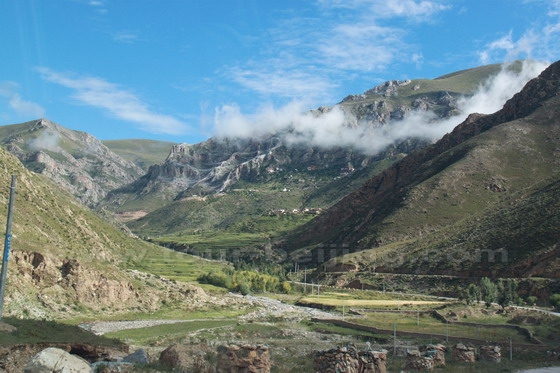
From Lhasa one can drive to a place called Tingri, a set starting point for driving to the camping base of Mt.Everst.   

Baiba Township of Shegar Town in Tingri, a springboard for going to the base of Mt.Everest.

 One can visit the Mount Everest Nature Reserve on the way and driving with endless twists and turns, and hairpin bends for 100km before reaching the campig base of Mt.Everest. 

Driving with endless twists and turns, and hairpin bends

 In the middle of the way, then go on to the Gula Pass which is the first focal point where Mount Everest is viewed. It stands at a height of 5200 meters.    

the Gula Pass which is the first focal point where Mount Everest is viewed.

 The Rongbu, one of the highest monasteries in the world, it lies at the base of the Rongbuk Glacier.   

The Rongbu, one of the highest monasteries in the world, it lies at the base of the Rongbuk Glacier.

 The last leg of the journey starts here and ends at the base camp of Mount Everest. From there on, only professional climbers are allowed in with gear to go and scale Everest.   

The last leg of the journey starts here and ends at the base camp of Mount Everest


All others can scale a hill and behold the magnificent spectacle in front of their eyes. There are not many experiences as mind boggling as viewing one of the most beautiful yet equally dangerous places in the world.

All others can scale a hill and behold the magnificent spectacle in front of their eyes


Where to Stay in Xian

April 27th, 2012


Plan your Xian tour? Xian is a very compact and walkable city, so no matter where you are going to stay you will easily get to the major attractions and shopping areas in Xian.
 
As an ancient capital in China, Xian now still keeps the fortifications built in Ming Dynasty (1368 – 1644), one of the oldest and best preserved Chinese city walls. You may stay within the city wall or outside the city wall. But most traveler prefer to stay inside the city wall. The wall measures 14 km in circumference, 12m in height, and 15–18m in width at the base.
 
The city layout within Xian City Wall is based on a grid pattern centrally denoted by the grand Bell Tower (钟楼), which levels out four main avenues clockwise: East avenue (Dong Dajie 东大街), South Avenue ( Nan Dajie 南大街), West Avenue  (Xi Dajie 西大街) and North Aevenue (Bei Dajie 北大街). Xian Railway Station  is just located on the northeast corner of Xian city wall while Xian Airport is located 40km northwest of Xian. 
 
Bell Tower Area
Bell Tower Area is the most central part of Xian with four main streets merged here. Under the Bell Tower, a newly completed Subway line 02 takes you to Xian North Railway Station or the exhibition center in the south. The Xian airport shuttle has one stop here in front of Xian Melody Hotel where you may get off or get on the shuttle bus to start or finish your Xian trip.
 
To the northwest of Bell Tower, there is a Starbucks (Bell Tower Shop).  Walk westward from the Starbucks, you will see some local famous restaurants providing Xian dumplings and Yangrou Paomo (Bread and Mutton Soup). Further west, you come across Drum Tower. North of Drum Tower is the famous Muslim Quarters.
 
Suggested hotels around Bell Tower:
Melody Hotel Xian,
 Citadines Xi’an Central
Bell Tower Hotel Xian
Ibis Hotel Xi’an
Xi’an Century Landscape Hotel
 
East Avenue Area
The East Avenue used to the most commercial street in Xian. Now its popularity is fading with its position having graduated taken by South Avenue and West Avenue. Outside the east gate of Xian City Wall is Shaanxi Song & Dance Theatre which puts on Tang Dynasty Music and Dance Show every day.
 
Suggested hotels around East Avenue: 
Grand Metro Park Xian 
Grand Metropark Hotel Xi’an
Grand Noble Hotel Xi’an
Canaan International Hotel
Super 8 Hotel Xi’an He Ping Gate
 
South Avenue Area.
The South Avenue is the shortest avenues of the four with its southern tip meets the South Gate of Xian City Wall. The South Avenue is lined with high end and upstart shopping malls. Its city wall south gate is often used as a tourist spot where people strart to work. Forest of Stone Tablets is also located to the east of the south gate.
 
Suggestes hotels around South Avenue:
Union Alliance Atravis Executive Hotel
Skytel Xi’an (Formerly Prince International Hotel)
 
West Avenue Area
The West Street is rebuilt in a Tang Dynasty architecture style. This is the most beautiful streat, especially sparkling in the evening.
 
Suggested hotels around West Avenue:
West Capital International Hotel
Rongmin International Hotel Xi’an
Meihua-Goldentang Internation Hotel
 
North Avenue Area
The North Avenue is the least commercial street of the four streets where Xian’s office buildings and government buidlings are dotted here and there around the North Avenue.
 
Suggested hotels around north avenue: 
Sofitel Xian on Renmin Square
Mercure on Renmin Square Xian
Huashan Mountain International Hotel
Aurum International Hotel
Xian colorful hotel apartment
Days Inn City Centre Xian
 
Xian Railway Station Area
Xian Railway Station is located on the northeast corner of the city wall. It is a very bustling and commecial area. On the east square of the train station, there are directly buses going to Terra-cotta Army and Huaqing Hotspring.
 
Suggested hotels around Xian Railway Station:
Grand Soluxe International Hotel Xi’An
Hilton Xi’an
Jinjiang Inn (Xi’an Jiefang Road)
 
South of Xian City Wall Area
The area outside the City Wall in the south is quite with some walkable attractions like Big Goose Pagoda and Shaanxi Museum.
 
Suggested hotels: Tangcheng Hotel Xian and Shangri-la Hotel Xian
 
Useful Xian Hotel Links
 
Any questions,  jus t drop a line.
 

Weishan Offers an Unforgettable Slice of China’s Beauty

April 27th, 2012


When one visits China, the travel itinerary includes Weishan in almost all the cases. This is because Weishan County boasts of some of the most beautiful places in the country. The Weibo Mountains have been called the “Quietest Mountains in China”. The county also has some important seats of Daoism. Student travels include visiting some extremely beautiful spots. The county holds historical, religious and spiritual importance.  

Places to Visit in Weishan

Weishan County in China boasts of some of the most scenic spots in the country. Nestled in the Weibo Mountains, there are many places which are mesmerizing to say the least. It is not a surprise that study abroad programs based in Yunnan and also elsewhere in the country make it a point to take students to this area during the weekend travels. These gap year program trips are not only fun but educational as well.  

These mountains have been the summer abode of various kings. Weibao Mountain is a holy Daoist mountain. The full name of the mountain is Weibaoshan Mountain and it is considered to be “The quietest mountain in China”. The county has been responsible for cradling one of the most well-known kings of the country; Xinluo was born here and grew up to be the ruler of the legendary Nanzhao Kingdom.  

This region is the hub of natural beauty and spirituality. It is easy to see why those who learn Chinese in China want to visit this place. There is Wenchan Hall in the mountains which is dedicated to a former regional Daosit ruler. It has been designed in accordance with the Daoist geomantic principles. It is in this hall that one gets to see the “Mural of Dancing”. This is the only ancient Daoist mural that is found in Yunnan Province.  

There are almost twenty two temples in these mountains. Therefore, summer programs for high school students could easily be busy for at least two days touring just the temples. The Qingxia Temple is a famous temple which is dedicated to the highest of the Daoist Gods. It is more popularly known as the Laojun temple and has been designed grandly. The interiors are stately and pristine. There is a considerable amount of walking involved to visit different sites because these mountains have remained untouched to maintain their sanctity.

 On the way to these mountains, East Lotus Village lies in the path. This village still bears the looks of a place that must have been there centuries ago. Small streets, traditional buildings and people cooking food the traditional way are all commonplace here, a part of the day to day life. If one wants to experience the religious fervor, then the best time to visit these mountains is between the 1st and the 15th of the second month of the Chinese Lunar Calendar. Daoist pilgrims flock here for the temple fair. 

It is known to everybody that China is not only the place for learning Mandarin. It has expansive beautiful places which have become popular among students and visitors alike.