


Lhasa Attractions
Lhasa Tours
Lhasa Hotels
Lhasa Food
Lhasa Shopping
Lhasa Nightlife
Lhasa Transportation

Lhasa Tours
Lhasa Hotels
Lhasa Food
Lhasa Shopping
Lhasa Nightlife
Lhasa Transportation

Dear Floria Zhao,
I'm writting you to say thanks for all your help in organizing our Tibet tour. We enjoy every second of them and also our tour guides were excelent!!! You, your tour agency and the tour guides made our trip to Lhasa a facinating one! We love your organization skills and every place you take us! Keep up the excelent work!!!
One again, thanks a lot!
Aranza Torrado
I'm writting you to say thanks for all your help in organizing our Tibet tour. We enjoy every second of them and also our tour guides were excelent!!! You, your tour agency and the tour guides made our trip to Lhasa a facinating one! We love your organization skills and every place you take us! Keep up the excelent work!!!
One again, thanks a lot!
Aranza Torrado
Beijing Tour
Xian Tour
Shanghai Tour
Guilin Tour
Datong Tour
Chengde Tour
Chengdu Tour
Chongqing Tour
Hong Kong Tour
Luoyang Tour
Lijiang Tour
Pingyao Tour
Inner Mongolia Tour
Harbin Tour
Hangzhou Tour
Huangshan Tour
Tianjin Tour
Qufu Tour
Mt.Taishan Tour
Jinan Tour
Qingdao Tour
Qinhuangdao Tour
Jiuzhaigou Tour
Zhangjiajie Tour
Xian Tour
Shanghai Tour
Guilin Tour
Datong Tour
Chengde Tour
Chengdu Tour
Chongqing Tour
Hong Kong Tour
Luoyang Tour
Lijiang Tour
Pingyao Tour
Inner Mongolia Tour
Harbin Tour
Hangzhou Tour
Huangshan Tour
Tianjin Tour
Qufu Tour
Mt.Taishan Tour
Jinan Tour
Qingdao Tour
Qinhuangdao Tour
Jiuzhaigou Tour
Zhangjiajie Tour
China Province Tour
Tibet Tour
Shandong Tour
Guangdong Tour
Fujian Tour
Qinghai Tour
Ninxia Tour
Guizhou Tour
Inner Mongolia Tour
Shandong Tour
Guangdong Tour
Fujian Tour
Qinghai Tour
Ninxia Tour
Guizhou Tour
Inner Mongolia Tour
Beijing Trip
Xian Trip
Shanghai Trip
Guilin Trip
Chengdu Trip
Chengde Trip
Inner Mongolia Trip
Datong Trip
Harbin Trip
Pingyao Trip
Luoyang Trip
Qufu Trip
Shangdong Trip
Hangzhou Trip
Lhasa Trip
Yangtze River Trip
Huangshan Trip
Xian Trip
Shanghai Trip
Guilin Trip
Chengdu Trip
Chengde Trip
Inner Mongolia Trip
Datong Trip
Harbin Trip
Pingyao Trip
Luoyang Trip
Qufu Trip
Shangdong Trip
Hangzhou Trip
Lhasa Trip
Yangtze River Trip
Huangshan Trip
- - - - - - - - - - - - - - - - - - - -
Beijing Travel Service
China Travel Agency
Beijing Travel Tips
Beijing Information
Beijing Travel Service
China Travel Agency
Beijing Travel Tips
Beijing Information
Home → China Travel Guide → Lhasa Travel Guide → Lhasa Attractions → Lhasa Ramoche Temple
Lhasa Ramoche Temple

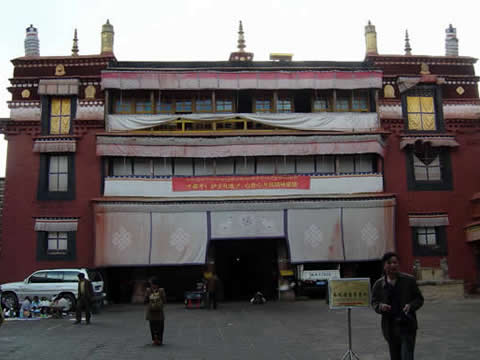
Remoche Temple is a Buddhist monastery, considered to be the most important temple in Lhasa after the Jokhang Temple. It is often called “Minor Jokhang Temple” and is located in the North part of Lhasa city, about 1 km from the Jokhang, covering an area of 4,000 square meters.
Ramoche Temple is one of the key cultural relic protection sites of the Tibet Autonomous Region as well as a popular attraction in Lhasa. Rachoche has a long history, and was founded at the same time as the Jokhang Temple. The original building complex has a strong Tang architecture influence, for it was first built by Han Chinese architects in the middle of the 7th century (during the Tang Dynasty). Han Princess Wencheng took charge of this project and ordered the temple be erected facing east to show her homesickness.
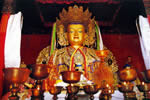
Remoche Temple was originally built to house the famous statue of Sakyamuni, now found in the Jokhang Temple, which was originally brought to Tibet by Princess Wencheng, It was said that when Princess Wencheng and her entourage arrived at the North gate of Lhasa, her carriage got stuck in the mud. Her assistants could not remove the statue and so they covered it temporarily with 4 pilllars and white brocade. Later, the Princess ordered the construction of Ramoche as a shrine for the statue. Twenty years later, in 652 A.D.,the leader of Tibet was concerned with rumours that the Chinese Emperor was considering an invasion of Tibet As a protection, he moved the Sakyamuni statue from the Ramoche to the Jokhang, and hid it from view. It had remained there ever since. In exchange Ramoche Temple received a smaller bronze statue of Sakyamuni, which has been brought to Tibet by Songtsan Gampo’s other wife, the Nepalese Princess Tritsun. This can still be seen at Ramoche Temple today.
For a fast answer, fill the email-form below and we'll get back to you by e-mail within 24 hours.
Lhasa Ramoche Temple

Remoche Temple is a Buddhist monastery, considered to be the most important temple in Lhasa after the Jokhang Temple. It is often called “Minor Jokhang Temple” and is located in the North part of Lhasa city, about 1 km from the Jokhang, covering an area of 4,000 square meters.
Ramoche Temple is one of the key cultural relic protection sites of the Tibet Autonomous Region as well as a popular attraction in Lhasa. Rachoche has a long history, and was founded at the same time as the Jokhang Temple. The original building complex has a strong Tang architecture influence, for it was first built by Han Chinese architects in the middle of the 7th century (during the Tang Dynasty). Han Princess Wencheng took charge of this project and ordered the temple be erected facing east to show her homesickness.
Remoche Temple was originally built to house the famous statue of Sakyamuni, now found in the Jokhang Temple, which was originally brought to Tibet by Princess Wencheng, It was said that when Princess Wencheng and her entourage arrived at the North gate of Lhasa, her carriage got stuck in the mud. Her assistants could not remove the statue and so they covered it temporarily with 4 pilllars and white brocade. Later, the Princess ordered the construction of Ramoche as a shrine for the statue. Twenty years later, in 652 A.D.,the leader of Tibet was concerned with rumours that the Chinese Emperor was considering an invasion of Tibet As a protection, he moved the Sakyamuni statue from the Ramoche to the Jokhang, and hid it from view. It had remained there ever since. In exchange Ramoche Temple received a smaller bronze statue of Sakyamuni, which has been brought to Tibet by Songtsan Gampo’s other wife, the Nepalese Princess Tritsun. This can still be seen at Ramoche Temple today.| Want a quick enquiry ? |