



Chinese Folk Customs
Wedding – Chinese Culture
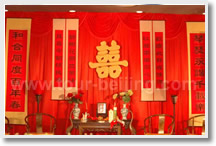
Marriage is the most important thing in the life.In China, a traditional wedding is simple and lively,ceremonious,and joyful.There are some unique features in this ceremony,but in modern society,especially in the city,it is hardly seen any more.
The bridal sedan is the core of the traditional wedding.In wedding,the bride should sit in the sedan,then be lifted from her mother’s home to her husband’s home.Generally,there are two kinds of sedan,that is,four-lifter and eight-lifter,also divided into “dragon sedan”and “phoenix sedan”.There are so many suites who hold gongs,umbrellas,fans and so on,besides lifters.
In group,there are more than ten people at least,and the occasion is very magnificent.In a traditional wedding,accompanied with a bridemaid,the bride wearing a red veil and led along by the bridesgroom who holds a red silk in his hand,enters the bridal sedan.
On the way to the husband’s home,lifters jolt the sedan as it it necessary in a joyful wedding,Lifters swing the sedan from left to right,causing the bride to sit unsteadily inside.Sometimes the bridegroom has to substitute for his bride or beg to veryone else,while,all laugh to adding to the jubilance.
The wedding ceremony is the most important part of a traditional Chinese wedding.The newlyweds go to the table for heaven and earth where there is a dou(a kind of basket) full of grain.The dou is written with “gold and jade fill the dou”on the brim and is sealed with red paper.
There are many coins placed in the four corners of the dou to provide the “luck” meaning to the guests.There is a cypress branch,called “ready source of money”,decorated with copper coins.Besides,one steelyard,a mirror,a loom,a lamp or a candle are also placed near the dou.
Afterwards,the groom stands on the left side,the bride right by his side,while the director prompts,“First bow to the heaven and earth;second bow to the parents;third bow to each other”.According the folk saying,they will not be the formal couple until bowing to the heaven and earth.As a result,people pay a great attention to this ceremony.An interesting custom is that if the groom cannot come to this ceremony,he should ask his sister to hold a cock instead.
After taking the bridal sedan,bowing to the heaven,it’s time for the newlyweds to go to the bridal chamber.According to custom,their relatives and friends get together in the bridal chamber to banter the newlyweds.At the same time,the newlyweds will never get angry even if the teasing games are a bit outrageous,but will try to skillfully dissolve since the relatives and friends intend to delight them.
Twelve Symbolic Animals – Chinese Culture
It is traditional in China, when a person is born, one animal is used to symbolize this year. Shuxiang, also called Shengxiao (any of the 12 animals representin the Eartly Branches), is a traditional way in China to number the years and to record a person’s age.
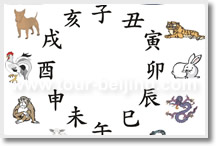
The 12 animals are Rat, Ox, Tiger, Rabbit, Dragon, Sanke, Horse, Sheep, Monkey, Chicken, Do, and pig. Therefore,when a person is born,he has an animal as his symbolic animal.The year 2002 was a renwu year under lunar calendar,also the Year of Horse,and so children born in this year are all Horse babies.
Even though the Chinese people now number the years and their age under the Gregorian calendar,they still continue to use the symbolic animals.As long as people know a person’s probable age and his symbolic animal,people can infer his exact age and year of birth.
Names of the Chinese People – Chinese Culture
The surnames of the Chinese people appeared during the matriarchal society, when clans were constituted with mothers at the center. And clans distinguished themselves from each other by using the name.
Some are one-character surnames, while others are compound surnames made up of two or more characters. Up to now, there is no exact statistic on how many surnames there are in China. Contermporary Chinese use about 3,500 Chinese surname. Among the 100 commonly used surnames ,the three most common are Li, Wang and Zhang; Zhuge, Quyang, Situ and Sima are the common compound surnames.
In China, the surname comes first, and is followd by the given name, and the latter has its own traditions and features. It can have one or two characters. In the same clan, the given name is arranged in the order of seniority in the family hierarchy.
And the given names of the peers ususally have one Chinese character in common if there are more than one character in their given names. The names of the ancient men were more complicated than those of the modern people. People of literary and status have both a style name and an alternative name, along with the surname and give name.
Chinese names usually have a certain meaning, expressing some kind of wihs. Some names embody the location, time or natural phenomenon when the person was born. Some names indicate the expectation of possessing some virtues. Some names have the meaning of health, longevity and happiness.
Male’s names are different from female ones: men’s names usually have the character meaning power and vigor. And the names of females usually use characters represectin gentleness and beauty.
Today, the Chinese do not pay as much attention to nameing, as did ancient folk. Generally, a person has an infant name and an official one, and the given names are not necessarily arranged in the order of the seniority in the family hierarchy. However, it is still the Chinese people’s wish to give their children a name which sounds good and meaningful.
Folk Temple Fair – Chinese Culture
The temple fair is a kind of social activity in China. The temple fair, usually on the open ground in or near a temple, is held on festive or specified days. Some are held only during the Spring Festival. Although different places hold their temple fairs at various dates, the contents are similar.
Farmers and merchants sell their farm produce, local specialties, and antiques, jade articles, flowers, birds and fish; craftsmen set up their stalls to show and sell their handicrafts and specialty snacks; folk artists establish a stage for singing, dancing, and quyi ( Chinese folk art forms, including ballad singing, story telling, comic dialogues, clapper talk, cross talk, etc.) performance. Ordinary people come to the temple fair to buy and sell goods, watch performances, and sample snacks, giving the temple fair a bustling atmosphere.
Now, Beijing holds many temple fairs every Spring Festival. Many goods sold in the temple fair have typical northern features, such as toys like diabolo, pinwheel, knife, spear, sword and halberd; big sugarcoated haws on a stick and gruel of millet flour and sugar are widely popular among common people.
Questions & Answers:
 Here is only for Questions and Answers. ( For anyone who wants to have an enquiry or customized tour, please email us to
  . )
. )